




























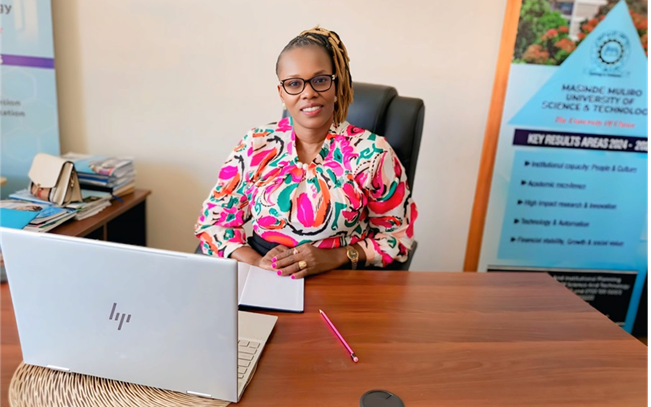
- Dr. Rose Opiyo’s appointment highlights her influence in shaping Africa’s future scholars and elevates MMUST’s continental profile.
- The selection process emphasized merit and diversity, while exposing low Kenyan student participation.
- Her role underscores the need to better prepare and position Africa’s youth for global academic opportunities.
In the quiet corridors of academia, where decisions often ripple far beyond lecture halls and conference rooms, moments of continental significance are forged. Such a moment has emerged from Masinde Muliro University of Science and Technology (MMUST), as one of its distinguished scholars steps onto a pan-African stage to help shape the intellectual future of the continent.
Dr. Rose Atieno Opiyo, Associate Dean in the School of Education at MMUST, has been appointed to serve as the East African representative on the Pan African University Master’s Admissions Selection Jury at the Institute of Governance, Humanities and Social Sciences. This appointment is not merely a professional milestone. It is a statement of trust in her scholarship, her integrity, and her deep commitment to academic excellence.
Her selection, formally communicated in early March 2026, places her among a select circle of scholars drawn from across Africa, entrusted with a responsibility that carries both weight and vision. At the heart of this role lies a singular task: identifying and selecting the continent’s most promising minds to join one of Africa’s most prestigious postgraduate programmes. In doing so, the panel does more than admit students. It curates the future leadership of Africa in governance, humanities, and social sciences.
The Pan African University, an initiative of the African Union, has steadily positioned itself as a flagship institution for advancing higher education, research, and innovation across Africa. Through its specialized institutes, it offers fully funded postgraduate programmes designed to nurture thinkers, policymakers, and innovators who can respond to Africa’s evolving challenges. The Institute of Governance, Humanities and Social Sciences, hosted in Cameroon by the University of Yaoundé II and the University of Buea, stands at the centre of this mission, focusing on disciplines that speak directly to Africa’s quest for unity, dialogue, and sustainable development.
It is within this context that Dr. Opiyo carried out her role between the ninth and twelfth of March 2026, during a rigorous selection exercise held at the PAUGHSS campus in Soa. The process brought together leading academics and governance experts from across the continent, each tasked with evaluating candidates drawn from diverse linguistic, cultural, and academic backgrounds. The stakes were high, the competition intense, and the expectations uncompromising.
Working alongside fellow Kenyan scholar Prof. Patrick Muthengi Muthoka of the University of Nairobi, Dr. Opiyo contributed to a meticulous and merit-driven process that demanded not only academic discernment but also cultural sensitivity and a deep appreciation of Pan African ideals. The selection spanned both Anglophone and Francophone Africa, underscoring the need for inclusivity and balance in identifying talent that reflects the continent’s diversity.
At the conclusion of this demanding exercise, thirty one exceptional scholars were admitted into the 2026 cohort. Each of these students will embark on a fully funded academic journey, supported through tuition, stipends, travel, and medical care. Yet beyond the financial investment lies something far more enduring: access to a vibrant network of African scholars, leaders, and institutions committed to shaping the continent’s future.
Reflecting on her experience, Dr. Opiyo described the process as both enriching and deeply consequential. She spoke of the profound responsibility that comes with selecting individuals whose ideas and leadership will influence Africa’s trajectory. In her words, each chosen student carries not only personal ambition, but the collective hopes of a continent seeking transformation through knowledge.
Her reflections also revealed an important concern. Despite strong Kenyan representation at the panel level, the number of Kenyan applicants shortlisted for interviews remained noticeably low. This, she noted, points to a need for greater awareness, mentorship, and deliberate preparation among students, to ensure that more qualified candidates step forward to seize such opportunities.
Dr. Opiyo’s appointment is, therefore, more than an individual achievement. It is a mirror reflecting both Africa’s progress and its gaps. It highlights the strength of its academic institutions, the credibility of its scholars, and the urgent need to expand access and readiness among its young people.
For Masinde Muliro University of Science and Technology, this moment stands as a reaffirmation of its growing continental footprint. For students across Africa, it is a reminder that the doors to global academic excellence are open, but require preparation, courage, and awareness to walk through.
And for Dr. Rose Opiyo, it is a defining chapter in a career dedicated not only to teaching and research, but to shaping the very systems that determine who gets the opportunity to lead, to think, and to transform Africa from within.
In the end, the story is not just about selection. It is about stewardship. It is about who sits at the table when the future of Africa is being decided, and how thoughtfully, fairly, and boldly those decisions are made.
YOU MAY ALSO LIKE: Revolutionizing Higher Education: How Kenya’s First Virtual University is Reshaping Access and Learning in the Digital Age