




























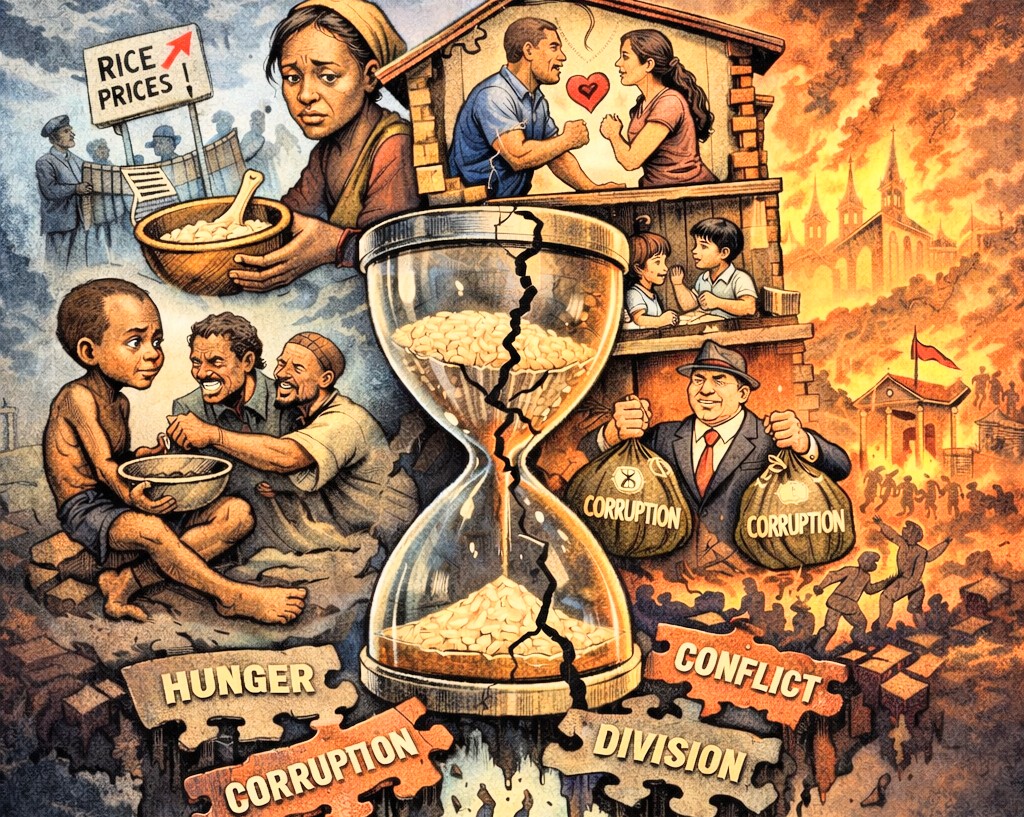
- Hunger is not just a physical crisis; it erodes dignity, fuels frustration, and quietly reshapes human behavior across society.
- As food insecurity deepens, relationships within families and communities fracture, replacing trust, patience, and empathy with tension and conflict.
- Without addressing both material needs and moral values, a nation risks not just economic decline, but a complete breakdown of its social fabric and identity.
There is a quiet truth that many societies ignore until it is too late. A nation does not collapse only because of politics or economics. It begins to weaken when its people no longer eat well and no longer live well with one another. In Sierra Leone today, the signs are no longer hidden. They are in our homes, in our streets, in our institutions, and in the way we speak to each other. The absence of good food and the breakdown of good relationships have eaten deep into the very fabric of our society.
Good food is not just about eating to survive. It is about nourishment, dignity, and stability. A society that feeds its people properly creates room for patience, clarity of thought, and emotional balance. But what happens when food becomes a daily struggle? What happens when families wake up not knowing what they will eat, or how they will eat, or if they will eat at all?
Hunger does not only weaken the body. It reshapes the mind. It shortens tempers. It removes empathy. It turns kindness into irritation and patience into anger. A hungry man is not simply someone looking for food. He is someone fighting an internal war that slowly strips him of his humanity. And when millions are fighting that same war, the nation itself becomes a battlefield.
Across Sierra Leone, the cost of living continues to rise while the quality of life continues to fall. Food that was once accessible is now out of reach for many. Basic meals that sustained families are now luxuries. Rice, the very symbol of survival, has become a burden for countless households. Mothers stretch meals beyond their limits. Fathers carry silent shame when they cannot provide. Children grow up not only underfed but emotionally strained by the tension that hunger brings into a home.
And where there is hunger, relationships begin to break.
A home without food rarely has peace. Conversations become arguments. Small disagreements become major conflicts. Respect fades. Love is tested in ways it was never meant to be tested. A husband who cannot provide begins to withdraw. A wife who is overwhelmed begins to resent. Children absorb the tension and learn to survive in silence or rebellion. The home, which should be a place of comfort, becomes a place of pressure.
From the home, this brokenness spreads into society.
You see it in the streets where people no longer have patience for each other. You hear it in the tone of everyday conversations where respect has been replaced with aggression. You feel it in public spaces where frustration has become the common language. People are quick to insult, quick to fight, quick to judge. It is not because Sierra Leoneans are naturally hostile. It is because they are carrying burdens that have not been addressed.
When people are not well fed, they are not well grounded. And when they are not well grounded, they cannot build healthy relationships.
But food alone is not the full story.
Even in times of hardship, strong relationships can hold a society together. There were times in Sierra Leone when families had very little, but they had each other. Neighbours shared what they had. Communities stood together. There was a sense of belonging that softened the edges of poverty. Today, that sense is fading.
Good relationships are built on truth, trust, and fairness. Yet what we see today is a growing culture of dishonesty, bias, and selfishness. People no longer trust each other. Words are no longer reliable. Promises are easily broken. Loyalty has become conditional. And when trust disappears, relationships collapse.
The authorities, who should set the standard, have instead deepened the problem. Decisions are often driven by bias rather than fairness. Truth is twisted to serve interests rather than justice. Those in positions of power act not as custodians of the people but as protectors of their own circles. This has created a dangerous message that spreads through society. If those at the top do not value truth, why should anyone else?
So the breakdown continues.
In offices, merit is replaced with favouritism. In communities, leadership is questioned. In families, respect for elders is eroded because the younger generation sees hypocrisy in the system they are told to trust. The very values that once held Sierra Leone together are now under pressure from all sides.
Bad manners are no longer isolated incidents. They have become a reflection of a deeper societal illness. When people are constantly frustrated, constantly struggling, and constantly disappointed, they begin to lose the discipline that holds behaviour in check. Politeness becomes a luxury. Respect becomes optional. And gradually, the culture shifts.
This is how societies decline, not with a loud collapse, but with a quiet erosion of values.
The tragedy is that many do not even recognise the connection between these issues. They see anger but do not see hunger behind it. They see conflict but do not see the broken relationships that feed it. They see corruption but do not see how it reflects a deeper moral hunger within the system.
Good food and good relationships are not separate matters. They are deeply connected.
When people are well fed, they are more patient, more focused, and more capable of building meaningful connections. When relationships are strong, people support each other through hardship, reducing the emotional and psychological impact of poverty. But when both are missing, the result is what we are witnessing today.
A society that is tired, angry, divided, and slowly losing its sense of identity.
Families are the foundation of any nation. When families are struggling with both hunger and broken relationships, the future becomes uncertain. Children raised in such environments carry the scars into adulthood. They grow up with limited examples of healthy communication, trust, and cooperation. They repeat what they have seen. And so the cycle continues.
What we are seeing in Sierra Leone is not just an economic crisis. It is a social crisis. It is a moral crisis. It is a crisis of care.
To address it, we must begin by recognising that development is not only about infrastructure or policies. It is about people. It is about how they live, how they eat, and how they relate to one another.
Food security must be taken seriously, not as a political promise but as a national priority. A nation that cannot feed its people cannot expect stability. But alongside that, there must be a deliberate effort to rebuild relationships at every level.
In families, there must be a return to communication, patience, and understanding. In communities, there must be a revival of shared responsibility. Among leaders, there must be a commitment to truth, fairness, and accountability.
Because without these, no amount of policy will fix what is broken.
Sierra Leoneans are not naturally divided. They are not naturally angry. They are reacting to conditions that have been allowed to grow unchecked. Beneath the frustration is a people that still longs for peace, dignity, and connection.
The question is whether we are willing to address the root causes or continue to treat the symptoms.
Good food restores strength. Good relationships restore humanity.
Without them, a nation may continue to exist, but it will not truly live.
YOU MAY ALSO LIKE: Food Insecurity in Africa: Challenges, causes and comprehensive solutions
Alpha Amadu Jalloh is a Sierra Leonean writer and public intellectual based in Australia, and the author of Monopoly of Happiness: Unveiling Sierra Leone’s Social Imbalance. Known for his bold and thought-provoking commentary on social and political issues, he is a leading voice in advancing conversations on Africa’s development. A multi-award-winning author, he is the pioneer recipient of the SMEGAfrica Excellence Awards 2025 Africa Renaissance Leadership Award, presented at the Inaugural Scholar Media Africa Conference in Nairobi. Contact: jalpha_amadu@hotmail.com