

























- Sierra Leone’s colonial experience was not merely occupation but a strategic reshaping of its land, economy, education, and governance systems to serve British imperial interests over local development.
- Through institutions, division of society, and indirect rule, the British created long-lasting structural and psychological systems that continued to influence Sierra Leone’s post-independence identity and governance.
- The legacy of colonialism in Sierra Leone persists not only in institutions and laws but also in mindset and dependency patterns, raising questions about the depth of true independence and self-determination.
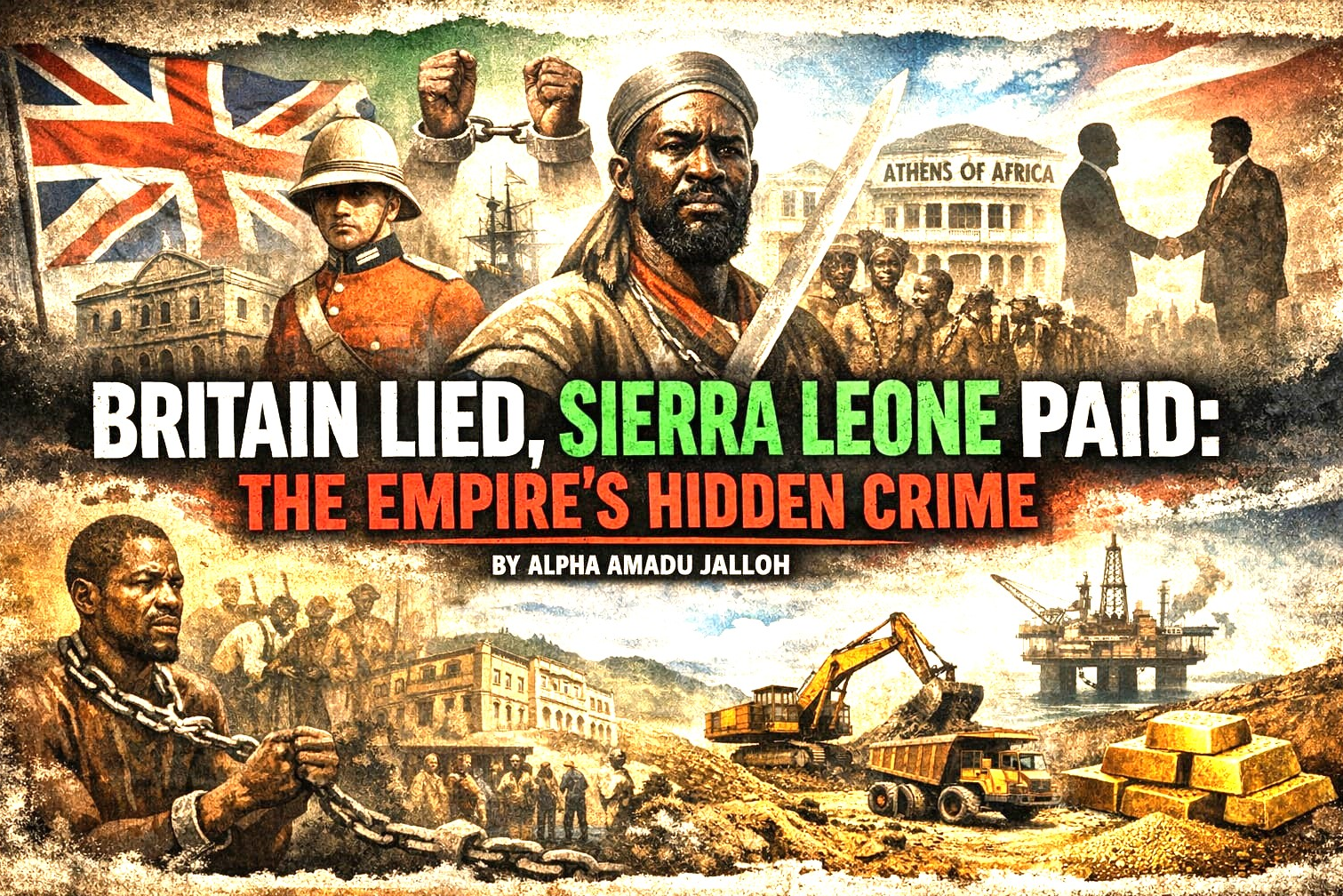
History has a way of dressing injustice in fine language. It tells stories of rescue, of civilization, of protection. But when you peel back the layers, when you walk through the lived experiences of a people, you begin to see something else entirely. Sierra Leone stands as one of the clearest examples of how a nation was not only misled by colonial promises but structurally altered in ways that continue to echo long after independence.
The British did not arrive in Sierra Leone as conquerors in the traditional sense. They came first as philanthropists, abolitionists, and merchants. That is how the story is often told. A land of freedom for liberated Africans, a Province of Freedom established in the late eighteenth century, a place where formerly enslaved people could rebuild their lives. That is the narrative. But even within that narrative lies the first deception.
The land itself was not empty. It belonged to indigenous communities whose political systems, economic networks, and social structures were already in place. The British secured land through agreements with local rulers, presenting these arrangements as mutual and beneficial. But these agreements were not what they seemed. They were the beginning of a long process where sovereignty was slowly diluted under the guise of partnership.
By 1808, Sierra Leone became a British Crown Colony, marking the transition from a company led experiment to direct imperial control. This shift was not simply administrative. It was transformational in the most damaging sense. From that moment, Sierra Leone ceased to be an evolving society shaping its own destiny and became a managed territory serving imperial priorities.
Freetown became the headquarters of British operations in West Africa. It was not just a settlement. It was a strategic outpost. The British used Sierra Leone as a naval base to enforce the abolition of the slave trade, intercepting ships and resettling freed captives there. While this appears humanitarian, it also served imperial interests by consolidating British presence along the West African coast.
The contradiction is striking. Britain abolished the slave trade, yet built an economy in Sierra Leone that did not prioritize indigenous development. Commerce replaced agriculture, and trade networks were shaped to benefit imperial interests rather than local prosperity. The nation was redirected from its natural economic path into one defined by external priorities.
Then came education, and with it, one of the most sophisticated deceptions ever introduced to Sierra Leone.
Institutions like Fourah Bay College, founded in 1827, were celebrated as symbols of enlightenment. Bo School, established in 1906, was designed to train the sons of chiefs into a colonial administrative order. These institutions were presented as gateways to knowledge, as tools of empowerment. Sierra Leone was proudly labeled the Athens of West Africa, a phrase that still lingers in our national pride.
But what did that really mean?
It meant that Sierra Leoneans were being shaped to admire a system that was not theirs. It meant that intelligence was measured by how closely one could mirror European thought, language, and worldview. It meant that education became less about strengthening indigenous identity and more about replacing it.
The title Athens of West Africa was not just a compliment. It was a carefully crafted illusion. It created a psychological framework that made people believe they had reached a pinnacle of intellectual civilization. Yet beneath that praise was a quiet control that ensured that the very knowledge being celebrated would not liberate but instead align minds with the colonial system.
An educated class was created, yes. But that class was trained to serve the colonial structure, not to dismantle it. They became intermediaries, not architects of a truly independent future. And over time, even that limited space was narrowed as British officials tightened their grip, reminding Sierra Leoneans that even their intellectual rise was conditional.
At the same time, the social fabric of Sierra Leone was being carefully divided. The colony in Freetown and the protectorate in the hinterland were governed differently. The Krio population, many of whom were descendants of freed slaves, were positioned as a distinct group, often privileged in education and administration. Meanwhile, indigenous communities were ruled indirectly through chiefs who answered to British authorities.
This was not accidental. It was a deliberate strategy.
Divide the people, manage their differences, and ensure they never unite in a way that challenges control.
The legacy of this division remains one of the deepest wounds in Sierra Leone’s national identity. It created layers of mistrust, subtle hierarchies, and a fragmented sense of belonging that continues to influence politics and social relations today.
And while all of this was happening, the British were building their empire elsewhere using the very resources and structures extracted from places like Sierra Leone. The wealth generated through trade, the strategic advantage of the colony, and even the intellectual contributions of educated Sierra Leoneans fed into a broader system that strengthened Britain and other parts of the empire.
Sierra Leone gave, but did not receive in equal measure.
Even the narrative of the slave trade, often framed as a moral victory for Britain, carries its own complexity. The same empire that later claimed to rescue Africans had earlier profited from their suffering. And in Sierra Leone, the aftermath of that trade created a society of returnees, recaptives, and indigenous populations brought together under a colonial system that did not prioritize unity. Instead of healing, it often deepened divisions, leaving behind a society still trying to reconcile its own identity.
Resistance did emerge. It had a name. It had a face. Bai Bureh stood as one of the fiercest symbols of defiance against British imposition during the Hut Tax War of 1898. He did not accept the forced taxation, the erosion of sovereignty, or the quiet takeover disguised as governance. He resisted for dignity, for autonomy, for the right of a people to determine their own future.
And what was the response?
He was captured, exiled, and removed from the very land he fought to protect. A man who stood for his people was silenced by a system that could not tolerate resistance. Around him, divisions deepened, and figures such as Kai Londo emerged within a fractured environment that weakened unified resistance. Whether through rivalry, manipulation, or circumstance, the result was the same. Unity was broken. Resistance was diluted. Control was secured.
This is how empires win. Not only by force, but by fragmentation.
But perhaps the deepest wound was not in land, nor in economy, nor even in social division. It was in governance itself.
British rule did not simply administer Sierra Leone. It injected stagnation into the very DNA of how the country would be governed. What was introduced was not a living, adaptive system, but a rigid structure designed for control, extraction, and obedience. That structure did not leave with independence. It remained, shaping how power is exercised and how decisions are made even today.
Many of the laws that still sit in our law books were never written to serve Sierra Leoneans. They were crafted to maintain order for the benefit of empire. Ordinances, public order laws, and administrative procedures were designed to suppress dissent, not to encourage participation. Yet decades after independence, many of these frameworks remain intact or only lightly altered. They continue to define the relationship between the state and the people.
A nation cannot move forward when it is governed by ideas that were never meant for its growth.
The system encourages hierarchy over accountability, authority over service, and compliance over innovation. It rewards those who preserve the old order rather than those who challenge it. It produces leaders who inherit power structures they do not fully control and citizens who navigate systems that do not fully represent them.
Even more dangerous is the psychological inheritance. Sierra Leone was taught to believe it had achieved a level of institutional sophistication that in reality was incomplete. The label of being advanced, of being the Athens of West Africa, created a sense of arrival without true foundation. It produced confidence without capacity, pride without structural independence.
And so we find ourselves in a painful contradiction.
We say we are independent, yet we continue to operate under the yoke of the fragments of British misguidance. The structures remain. The laws remain. The mindset remains. Independence was declared, but in many ways, it was never fully internalized or structurally realized.
A nation that believes it has systems, yet struggles to make those systems work. A country that inherited governance, but not ownership of that governance. The result is a cycle of imitation, where reforms are cosmetic rather than transformative, where laws are updated in language but not in spirit.
And as history has shown, what was taken did not end in the past. Sierra Leone’s wealth, its resources, its strategic value have continued to flow outward in different forms. What once happened through direct colonial control now often appears under new names. Diplomacy. International partnership. Development agreements. Yet beneath these labels, the imbalance often remains, with benefits disproportionately leaving while the nation continues to struggle to stand fully on its own.
By the time independence came in 1961, Sierra Leone inherited borders it did not design, systems it did not create, and divisions it did not choose. The structure appeared complete, but it was fundamentally unbalanced.
Independence did not erase those realities. It revealed them.
And so the question must be asked with honesty.
Was Sierra Leone ever truly allowed to develop on its own terms?
Or was it guided, shaped, and ultimately misled into a version of itself that served others more than it served its own people?
The British did not just rule Sierra Leone. They influenced how Sierra Leoneans see themselves. They introduced systems that rewarded imitation over authenticity. They created institutions that appeared empowering but often reinforced dependency. They built a narrative of progress that masked a deeper form of control.
And perhaps the most enduring impact is not physical. It is mental.
A mindset that seeks validation from outside. A belief in labels that were never fully earned. A struggle to reconcile pride with reality.
History will continue to celebrate certain milestones. It will highlight institutions, praise achievements, and repeat familiar narratives.
But the truth lives beyond those headlines.
The truth is that Sierra Leone was not just colonized. It was carefully redirected. Its path was altered in ways that made it difficult to return to what it once was. Its people were not just governed. They were conditioned to think in ways that aligned with external interests.
And until that truth is fully confronted, the question will remain.
Not whether Sierra Leone was misled.
But whether we have truly understood how deep that deception runs, and whether we have the courage to finally break free from it.
YOU MAY ALSO READ: Empty Stomachs, Fractured Souls: The Silent Unraveling of a Nation
Alpha Amadu Jalloh is a Sierra Leonean writer and public intellectual based in Australia, and the author of Monopoly of Happiness: Unveiling Sierra Leone’s Social Imbalance. Known for his bold and thought-provoking commentary on social and political issues, he is a leading voice in advancing conversations on Africa’s development. A multi-award-winning author, he is the pioneer recipient of the SMEGAfrica Excellence Awards 2025 Africa Renaissance Leadership Award, presented at the Inaugural Scholar Media Africa Conference in Nairobi. Contact: jalpha_amadu@hotmail.com