




























- The initiative promised to harmonize university standards, enable seamless movement of students and academic staff, and ensure that degrees earned in one member state would be recognized across the region.
- The most significant and far-reaching effort so far is the Regional Quality Assurance Project, which gained traction in universities across all member states and has become a continental success story.
- Unless member states move beyond declarations and deliver concrete reforms, the initiative risks deepening disillusionment among students, academics, and employers who had pinned their hopes on a truly integrated education space.
When the East African Community (EAC)—a regional bloc bringing together Kenya, Uganda, Tanzania, Rwanda, Burundi, South Sudan, Somalia, and the Democratic Republic of Congo—unveiled the Common Higher Education Area (CHEA) in Dar-es-Salaam, Tanzania, on the 20th day of May 2017, it was celebrated as a breakthrough for education and regional integration. The initiative promised to harmonize university standards, enable seamless movement of students and academic staff, and ensure that degrees earned in one member state would be recognized across the region.
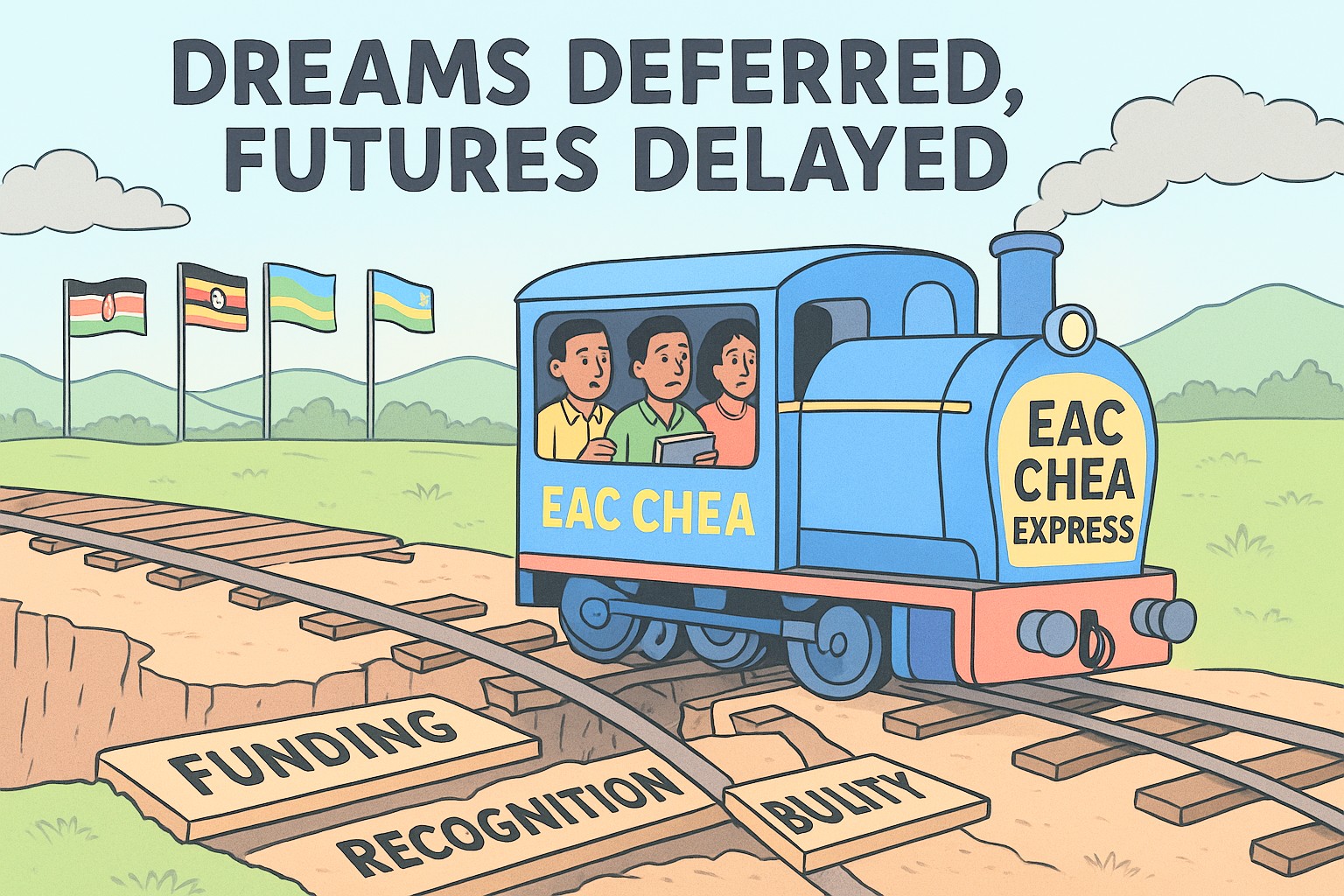
Yet, nearly a decade later, the lofty vision has struggled to move beyond policy documents and conference halls. For many stakeholders, the CHEA remains more of an aspiration than a lived reality, with limited tangible impact on universities, graduates, or the labour market.
Objectives of CHEA
The idea behind the CHEA was to create a single, seamless academic space within the EAC, enabling universities and colleges across member states to operate under shared standards. By aligning education systems, the bloc aimed to make higher learning a driver of regional integration, economic growth, and global competitiveness.
At the heart of this vision were several key goals. First was the harmonization of curricula and quality standards, ensuring that degrees and academic programs in the EAC member states would meet comparable benchmarks. Central to this effort is the East African Qualifications Framework for Higher Education (EAQFHE), designed to guide recognition of academic awards and professional credentials across borders.
The CHEA also sought to establish a regional credit transfer and mobility scheme, allowing students and staff to move freely among universities without bureaucratic obstacles or the need to repeat coursework. In addition, the initiative envisioned strengthened research collaboration and the creation of regional centers of excellence, pooling expertise and resources to tackle common challenges in science, technology, health, and innovation.
In theory, these measures would not only raise academic standards but also expand opportunities for East African graduates, making the region a more attractive destination for education and skilled labour.
Progress on Paper
Since its launch, the CHEA has not been entirely dormant. The EAC, through the Inter-University Council for East Africa (IUCEA), has rolled out several policies and frameworks aimed at laying the groundwork for a unified academic space. Among the most notable are the EAQFHE, which sets common benchmarks for degree recognition, and regional quality assurance guidelines meant to standardize accreditation and evaluation across member states.
Several pilot projects and memoranda of understanding (MoUs) have linked universities across the region in an effort to test the feasibility of cross-border academic mobility. A handful of institutions have experimented with credit transfer schemes, student exchanges, and joint research programs, initiatives that EAC officials often cite in communiqués as proof that the CHEA is slowly taking shape.
The most significant and far-reaching effort so far is the Regional Quality Assurance Project, which gained traction in universities across all member states and has become a continental success story. The project has produced multiple cohorts of Quality Assurance Champions who continue to drive its sustainability. From this initiative emerged the East African Higher Education Quality Assurance Network (EAQAN), along with vibrant national chapters such as the Kenya Universities Quality Assurance Network (KuQAN), the Ugandan Universities Quality Assurance Forum (UUQAF), Rwanda Higher Education Quality Assurance Network (RWAQAN), Forum Burundais d’Assurance Qualité (FOBAQ), Somali Universities Quality Assurance Network (SUQAN), and the Tanzanian Universities Quality Assurance Forum (TUQAF), among others, to localize efforts and strengthen country-level quality assurance coordination and providing ongoing platforms for collaboration and best-practice sharing.
EAC ministers and IUCEA officials frequently issue statements celebrating “achievements”, pointing to policy documents, training workshops, and agreements as signs of progress. Yet, while these initiatives demonstrate political intent and provide a framework for future cooperation, they remain largely confined to the policy realm. For many students and lecturers, the changes are more visible in conference reports than in everyday academic practice.
Policy and Practice Gaps
Despite the impressive array of agreements and policy frameworks, the CHEA has yet to translate into meaningful change on the ground. One of the biggest hurdles is the persistent disparity in national education systems, accreditation processes, and funding models across EAC member states. While some countries have advanced quality assurance mechanisms and well-resourced universities, others struggle with underfunded institutions and outdated regulatory structures, making harmonization slow and uneven.
The regional credit transfer and mobility programs, which were expected to enable students to move freely between universities, have recorded very low uptake. Many universities have yet to integrate the credit transfer guidelines into their academic calendars, and students who attempt cross-border transfers often encounter bureaucratic delays or are forced to retake courses.
Compounding the problem is minimal awareness of CHEA initiatives among those meant to benefit most. In many institutions, administrators, students, and even employers remain largely uninformed about the existence of regional frameworks such as the EAQFHE. Without grassroots understanding and demand, the policies risk remaining little more than technical documents.
Above all, the CHEA suffers from limited political will and inconsistent implementation. Some member states have been slow to domesticate regional agreements into national laws, while shifting political priorities frequently stall progress. As a result, the lofty ambitions of seamless academic mobility and mutual recognition of qualifications remain more a matter of regional rhetoric than day-to-day reality.
Stakeholder Analysis
As a former University Vice-Chancellor during the signing of the CHEA agreement by EAC heads of state—and one of the academic leaders charged with driving its implementation—I carry a blend of optimism and frustration. In my years as a university administrator, I repeatedly encountered bureaucratic obstacles that made progress painfully slow, even when sound policies were already in place. The frameworks existed, but turning them into reality demanded new regulations, adequate budgets, and intensive staff training that many institutions simply could not sustain.
From my perspective as an education expert—and one that may be shared by representatives of the IUCEA—the pace of integration has been disappointingly sluggish. True harmonization requires serious political will to implement the agreements the countries enthusiastically signed.
Underlying Challenges
Behind the slow progress of the CHEA lie structural obstacles that go beyond policy design. One major hurdle is the uneven infrastructure and investment in higher education across EAC member states. While some universities in Kenya and Uganda boast advanced research facilities and digital systems, others—particularly in newer or less resourced member countries—struggle with outdated laboratories, inadequate libraries, and chronic underfunding. This disparity makes it difficult to set and enforce common quality standards.
Language differences further complicate harmonization. The EAC operates in English, French, and Kiswahili, reflecting the region’s colonial histories and diverse cultures. Drafting curricula, qualifications frameworks, and quality assurance guidelines that work seamlessly across these languages remains a slow and costly process, often requiring extensive translation and interpretation.
The CHEA has also been hindered by political tensions within the bloc, including periodic trade disputes, border closures, and competing national priorities. These tensions frequently stall regional projects, delay ratification of agreements, and sap momentum from integration efforts.
Additionally, insufficient and inconsistent funding threatens the sustainability of CHEA programs. Many initiatives depend on donor support or short-term project financing, like the German Academic Exchange Service (DAAD), German Rectors Conference (HRK), Dialogue on Innovative Higher Education Strategies (DIES, OBREAL etc leaving universities without the long-term resources needed to implement mobility schemes, maintain quality assurance, or invest in collaborative research. Without stable financial backing, even the most ambitious regional education policies risk remaining aspirational rather than actionable.
Implications of Inaction
The failure to fully implement the CHEA carries significant costs for the East African region. Chief among them is the loss of opportunities for student and staff mobility. Without a functioning credit transfer system and automatic recognition of degrees, thousands of students who might have benefited from cross-border education are forced to remain within their home countries or navigate cumbersome, expensive verification processes. Academic staff also miss out on the chance to teach or conduct research across the region, limiting the exchange of knowledge and innovation.
These barriers create inefficiencies in the regional labour market, as graduates often struggle to have their qualifications recognized in neighboring countries. Employers, in turn, face uncertainty when hiring foreign-trained candidates, leading to missed opportunities to tap into a broader talent pool that could address common regional challenges. This lack of mobility undermines the very purpose of the East African Community’s economic integration, which depends on the free movement of skills to drive growth.
The inaction also leaves East African universities weakly positioned on the global stage. While other regions, such as the European Union with its Bologna Process, have leveraged harmonized education systems to attract international students and research funding, East Africa risks falling behind. Without swift action to implement CHEA commitments, the region’s universities may struggle to compete for partnerships, grants, and top-tier scholars in an increasingly interconnected world.
Nearly a decade after its launch, the EAC Common Higher Education Area remains a striking example of the gap between ambition and action. What was envisioned as a transformative platform for harmonized standards, academic mobility, and mutual recognition of qualifications has instead become a promissory note, rich in policy documents but poor in practical results. Unless member states move beyond declarations and deliver concrete reforms, the initiative risks deepening disillusionment among students, academics, and employers who had pinned their hopes on a truly integrated education space. The EAC must now match its bold commitments with decisive implementation to ensure that CHEA becomes not just an idea on paper, but a lived reality shaping the region’s future.
YOU MAY ALSO READ: Kenya’s Education Journey: Achievements, Gaps, and Policy Recommendations
The author, Prof. Maurice O. Okoth, is a Professor of Chemistry at the University of Eldoret, a former Vice-Chancellor, and a Higher Education and Quality Assurance expert. Contact: okothmdo@gmail.com