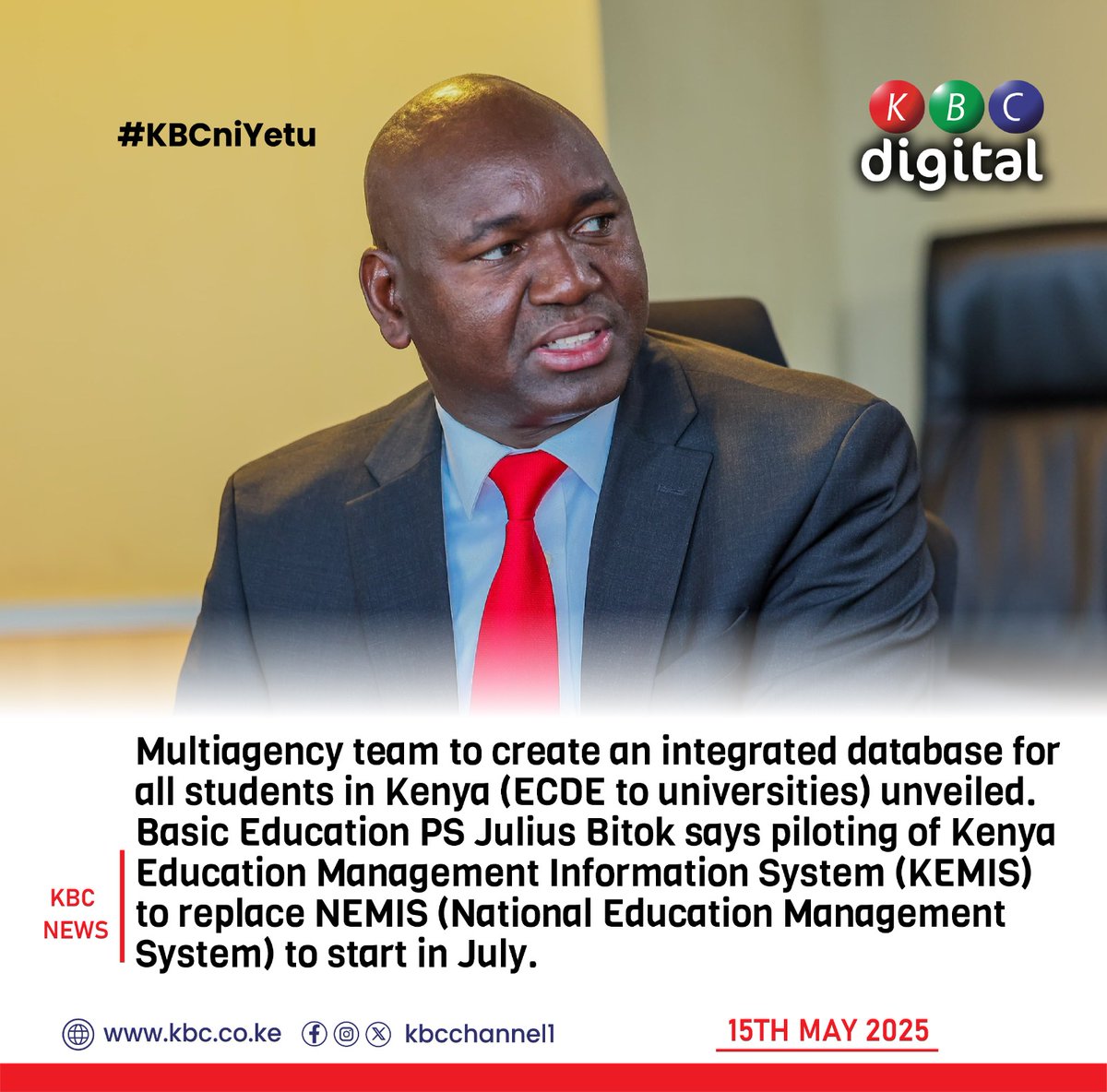































- Through unique personal identification numbers, NEMIS was designed to support the Ministry of Education in monitoring student enrolment, tracking resource distribution, managing capitation funds, and enhancing accountability within public schools.
- Frequent system downtimes and poor user experience have made NEMIS cumbersome for school administrators and education officers.
- Transitioning to KEMIS is not just a technological upgrade—it is a strategic move toward building an adaptive, inclusive, and tech-driven education system that can respond to emerging challenges with speed and precision.
In 2018, Kenya took a bold step toward digitizing education data management by launching the National Education Management Information System (NEMIS). The system was introduced to streamline the collection, analysis, and dissemination of education data. While NEMIS has played a significant role in centralizing education records, its limitations have hindered its effectiveness.
To address these shortcomings, the Ministry of Education is proposing the adoption of a more robust and technologically advanced platform: the Kenya Education Management Information System (KEMIS). Designed to address the shortcomings of NEMIS, KEMIS is poised to take educational data management to the next level.
Limitations of NEMIS
The NEMIS was part of Kenya’s broader initiative to digitize education services. The system aimed to create a centralized database for all learners, teachers, and institutions across the country. Through unique personal identification numbers, NEMIS was designed to support the Ministry of Education in monitoring student enrolment, tracking resource distribution, managing capitation funds, and enhancing accountability within public schools.
Heads of Institutions will bear me witness that despite the noble objectives, NEMIS has faced several critical challenges that have hindered its full potential. One of the most pressing issues is inaccurate and outdated data. Many schools, especially in marginalized areas, lack the technical capacity or internet access to update learner records regularly. As a result, the system often contains mismatched details, such as students who have transferred or dropped out still appearing as active, leading to distorted statistics that affect funding and policy decisions.
Moreover, frequent system downtimes and poor user experience have made NEMIS cumbersome for school administrators and education officers. Users have often reported that the system is slow, prone to crashing, or completely inaccessible during peak periods—such as during annual capitation allocations or registration drives. These inefficiencies frustrate users and undermine the system’s reliability.
Another major limitation is limited access in rural and remote areas, where infrastructure such as electricity and internet connectivity is unreliable or non-existent. This digital divide means that schools in counties like Turkana or West Pokot struggle to participate fully in the system, leaving many learners unregistered or underrepresented in national data.
NEMIS suffers from poor integration with other government data systems. For instance, it operates in isolation from platforms such as e-Citizen, and the National Registration Bureau, making cross-referencing data cumbersome. This lack of interoperability reduces the efficiency of services like birth certificate verification for learner registration and coordination with health or social welfare programs.
These limitations point to the urgent need for an upgraded, inclusive, and smarter data management platform that can support the dynamic needs of Kenya’s evolving education system.
The Case for KEMIS
KEMIS has been proposed as a next-generation platform that addresses the current system’s inefficiencies while embracing technological advancements. KEMIS is not just a replacement but a comprehensive upgrade aimed at transforming how education data is collected, analyzed, and used to support national development goals. The system will link student data from ECDE, primary, secondary, tertiary institutions, and universities into a centralized database. The promises of KEMIS are more superior and outweigh the operations of NEMIS.
One of the key strengths of KEMIS lies in its upgraded digital infrastructure, which enables real-time data updates and cloud-based storage. Unlike NEMIS, where delays in data entry can lead to inaccuracies, KEMIS allows school administrators to upload learner records, attendance, and assessment results instantly. This real-time capability ensures that the Ministry of Education always has access to the most current data, making it easier to respond swiftly to issues such as student dropouts, disaster impacts on schooling, or urgent infrastructure needs. The result is more informed and timely decision-making in policy development and resource allocation.
KEMIS is also built with interoperability in mind, enabling seamless integration with other critical government platforms such as e-Citizen, the Social Health Insurance Fund (SHIF), and the Ministry of Health. This connectivity supports a holistic learner profile that includes not just academic performance but also health records, social welfare data, and civil registration. Such inter-agency coordination is crucial for implementing school feeding programs, tracking immunization among school-age children, and targeting educational support to vulnerable learners. It reduces duplication of efforts and enhances efficiency across sectors.
Another major improvement is the user-friendly design of KEMIS. The platform incorporates a mobile-friendly interface to cater to users in remote areas who rely on smartphones rather than desktops. Additionally, its simplified dashboard provides school heads, teachers, and county education officers with easy-to-navigate menus and visual data summaries. These features reduce the learning curve and enhance productivity, especially for users with limited digital skills. With fewer technical hurdles, schools in marginalized areas will fully participate in national data management efforts.
Perhaps most importantly, KEMIS is designed to serve as a strategic tool for policy formulation and educational planning. The system includes built-in data analytics and predictive modeling tools, enabling education authorities to anticipate trends such as enrollment surges, teacher shortages, or infrastructure deficits. This foresight allows for proactive measures—such as recruiting teachers ahead of time or constructing new classrooms in high-growth regions. KEMIS also supports the implementation of curriculum reforms by tracking the uptake and performance of new learning areas and competencies.
Counterarguments
While the case for transitioning from NEMIS to KEMIS is strong, some critics have raised legitimate concerns about the feasibility of such a move, citing high cost of transition and resistance to change from stakeholders. While cost and resistance are valid concerns, they are however, are not insurmountable. They are therefore, not reasons enough to cling to an outdated system that is not currently serving efficiently. Through strategic investment and inclusive implementation, Kenya can overcome these challenges and embrace a more efficient and future-ready education data platform.
In essence, KEMIS is not just a data system—it is a platform for transformation. By offering real-time access, seamless integration, intuitive design, and analytical capability, KEMIS presents a compelling case for modernizing Kenya’s education management infrastructure.
In an era where data drives policy, efficiency, and accountability, Kenya’s education system must evolve to meet the demands of a dynamic and digital world. The limitations of NEMIS have made it clear that relying on outdated and rigid platforms hampers the country’s ability to deliver quality education equitably and effectively. Transitioning to KEMIS is not just a technological upgrade—it is a strategic move toward building an adaptive, inclusive, and tech-driven education system that can respond to emerging challenges with speed and precision.
The government, in collaboration with all education stakeholders, must prioritize the adoption and implementation of KEMIS. This includes allocating resources, offering user training, and ensuring the system is accessible across urban and rural regions alike. By embracing KEMIS, Kenya takes a bold step toward transforming its education sector into a modern, data-driven engine of national development.
YOU MAY ALSO READ: BOOK REVIEW: Basic Education in Kenya: A Reality Check
The Author is a Professor of Chemistry at University of Eldoret, a former Vice-Chancellor, and a Higher Education expert and Quality Assurance Consultant. okothmdo@gmail.com