





























- Democracy does not collapse only because of bad leaders. It also weakens when good citizens choose silence, disengagement, and convenience over civic responsibility.
- Every election is a mirror of collective national choices. The quality of leadership a society produces is often shaped by the participation, vigilance, and courage of its citizens.
- A constitution can guarantee rights and freedoms, but only an informed and active citizenry can transform those promises into lived reality.
We had all been in that position before; you must do what your master says or lose your job. But I tell you, a man who does that has no more honour than a dog.
A Man of the People by Chinua Achebe.
I remain befuddled. Genuinely, existentially, magnificently befuddled. This happens each time I encounter the citizen who declares, with the serene confidence of a man who believes he has solved a great philosophical puzzle, that they “do not do politics.”
The phrase rolls off the tongue with practiced ease and comfortable nonchalance. It is spoken as though politics were a lifestyle choice like veganism or CrossFit. Something one simply opts out of by personal preference. As though governance were a subscription service one could cancel with a text message.
But Achebe’s antihero, Chief Nanga, understood something the modern Kenyan apologist refuses to absorb. The bargain between the citizen and the state is not honourable neutrality. At its most passive, it is surrender. And in Kenya, surrender has a price. That price is measured in fuel costs, collapsed hospitals, and the slow erasure of a generation’s potential.
The Constitution of Kenya 2010 does not open with the voice of Parliament. It does not begin with the proclamation of a president or the opinion of judges. It opens with the people.
“We, the people of Kenya,” declares the Preamble. The language is categorical, unequivocal, and deliberately placed at the threshold of the supreme law. One must either take it seriously or admit that constitutional democracy in this country is merely elaborate theatre without audience or consequence.
The Preamble commits the nation to “nurturing and protecting the well being of the individual, the family, communities and the nation.” It also commits Kenya to “governing ourselves based on the essential values of human rights, equality, freedom, democracy, social justice and the rule of law.”
Every phrase points toward participation. Governing ourselves. Not being governed. Not watching others govern. Ourselves.
Article 1 of the Constitution is even more explicit. If constitutional provisions could shout, Article 1(1) would be screaming from every rooftop between Lokichar and Mombasa:
“All sovereign power belongs to the people of Kenya and shall be exercised only in accordance with this Constitution.”
Article 1(2) goes even further. One suspects the drafters anticipated citizens who would later claim political disengagement as a virtue:
“The people may exercise their sovereign power either directly or through their democratically elected representatives.”
The ballot paper is not a bureaucratic inconvenience. It is the instrument through which sovereignty travels from its rightful owner, the citizen, to its temporary custodian, the elected representative.
When citizens refuse to vote, they do not neutrally withhold sovereignty. They hand it over, unwrapped and unguarded, to whoever else shows up.
And so we come to the first tribe of the disengaged. These are those who announce, with the gravity of someone declining a second helping at dinner, that they “do not do politics.”
One must marvel at the architecture of this self deception.
Every morning this citizen wakes up and encounters politics.
The matatu fare that consumes forty percent more of their wage than it did three years ago? Politics.
The public hospital that sends their mother home with a prescription it cannot fill because procurement money disappeared into corruption? Politics.
The road that swallows a tyre and an axle on the same Tuesday? Politics.
The school running three shifts because constituency development funds built only a wall around an unfinished dream? Politics.
The citizen who does not do politics is not liberated from politics. They are merely subjected to it without consent, voice, or recourse. In practical terms, this condition resembles the colonial reality their forebears struggled to escape.
The second tribe is philosophically more ambitious, though no less intellectually dishonest. These are the fatalists. They believe elections are rigged and outcomes predetermined. They therefore treat abstention as protest.
There is a theatrical romanticism to this position. It carries the aesthetic of principled resistance. The weary dissident refusing participation in a rigged game.
But their abstention changes nothing about the rigging. Instead, it removes the only counterweight against it.
If elections are stolen, they are easier to steal when honest votes number in the hundreds instead of the millions. The stolen margin shrinks when genuine participation grows.
Abstention in protest against electoral fraud is politically equivalent to refusing to wear a seatbelt because reckless drivers exist. The statement may be clear, but the consequences remain fatal.
One must also observe that the fatalist who declines to vote because the result is predetermined conveniently spares themselves the inconvenience of queuing, researching candidates, and exercising civic responsibility. Yet they still claim moral superiority at no personal cost.
History has not been generous to those who sat it out.
The architects of Kenya’s 2010 Constitution did not conclude that constitutional reform was impossible. The generation of 1992 did not surrender because KANU’s grip on power seemed permanent.
They pressed forward. They bled. They registered. They voted. Imperfectly and painfully, something shifted.
Sovereignty is never reclaimed by the passive. It is reclaimed by the present.
The third tribe is perhaps the most poignant because its excuse is the most human. These are citizens who are simply too busy.
The queue is long. The sun is hot. The day is short. There is a meeting to attend, a delivery to make, a child to collect, a deal to close.
Life crowds out the vote.
By the time the polling station closes, they have accomplished everything except the one act that shapes the conditions under which all the other acts of their lives will occur.
These citizens are not lazy or villainous. They are operating with a catastrophically short time horizon. They optimize the day while neglecting the decade.
They become so absorbed in survival that they forget to participate in the decisions shaping survival itself.
Ironically, the busier a citizen is, the more they need good governance, functioning infrastructure, predictable regulation, honest procurement, and accessible healthcare. That means they can least afford to skip elections.
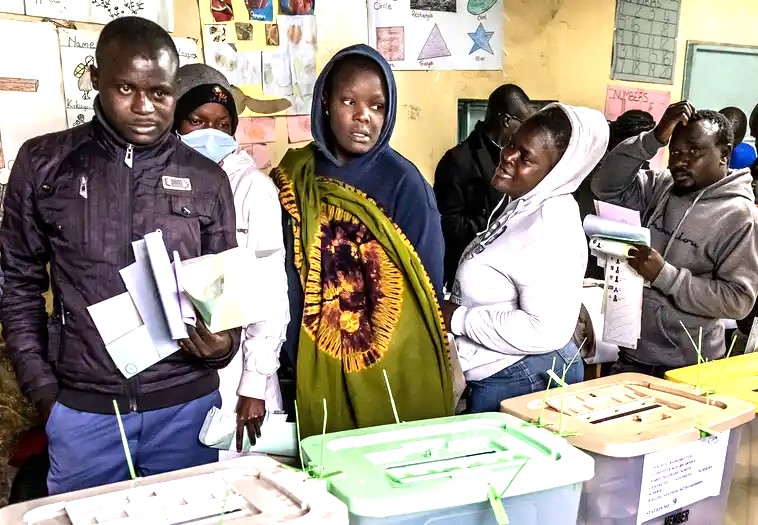
The voters’ card, that small laminated rectangle issued by the Independent Electoral and Boundaries Commission, is not a collector’s item or administrative curiosity.
It is the physical manifestation of Article 38 of the Constitution. It guarantees every citizen the right to free, fair, and regular elections. It transforms constitutional identity into constitutional power.
Without civic participation, rights in the Bill of Rights risk becoming decorative. Beautiful, admired, and inert.
The voter’s card is not a privilege extended by the state. It is a tool citizens must collect and use.
Leaving it uncollected is like inheriting a machete and complaining that the bush is overgrown.
There is also a failure of collective imagination within Kenyan political culture. Elections are often treated as events that happen to communities instead of choices communities make.
The ward representative who awards tenders to relatives. The member of parliament who appears at funerals and disappears from Parliament. The governor whose development record consists largely of groundbreaking ceremonies for abandoned projects. These are not natural disasters.
They are elected consequences.
Every one of these leaders entered office through a combination of votes cast and votes withheld. The distinction between those two acts is less meaningful than disengaged citizens imagine.
The person who did not vote still contributed to the outcome through absence.
Kenya does not always suffer poor leadership because it lacks good citizens. Sometimes it suffers poor leadership because good citizens outsourced leadership selection to less discerning neighbours.
The constitutional architecture framing this conversation was not assembled carelessly. The Committee of Experts behind the 2010 Constitution drew from international best practice, comparative constitutional law, and extensive public participation.
The result was one of Africa’s most progressive constitutional instruments. It created a sophisticated devolution framework, a robust Bill of Rights, and institutional safeguards capable of producing accountable governance.
But the Constitution is not self executing.
It requires citizens who know it, invoke it, defend it, and elect leaders committed to it.
A constitution without civic engagement is a map without travellers. Intricate, detailed, and entirely useless.
The election of good leaders is not mystical. It is analytical. It demands the same rigour citizens apply to every consequential decision in their lives.
No one purchases land in Kenya without conducting due diligence. Citizens examine titles, cautions, encumbrances, and transaction histories.
No one enters a business partnership without assessing character, track record, and financial probity.
Yet the same citizen who spends three weeks scrutinizing a five acre plot in Kitengela will vote, or fail to vote, for an individual controlling billions of shillings in public resources based on tribal affiliation, branded T shirts, or promises delivered at a harambee.
The asymmetry is staggering.
We perform due diligence on investments and delegate governance to instinct and inertia.
It is worth recalling that the generation which fought for the repeal of Section 2A of the former Constitution did not struggle from positions of comfort or safety.
Kenneth Matiba suffered a stroke in detention. Raila Odinga endured years of imprisonment. Paul Muite argued before courts structured against him. Charity Ngilu campaigned in an environment where women in politics were treated as aberrations.
These were not people who had exhausted all alternatives. They chose civic engagement over personal safety because they understood governance is never someone else’s problem.
The freedoms modern Kenyans exercise casually today, including the freedom to declare on social media that they “do not do politics,” were purchased at tremendous cost.
Article 73 of the Constitution establishes that leadership is a public trust. Public officers must exercise authority transparently, accountably, and responsively.
But every trust has two parties. The trustee and the beneficiary.
The elected leader is the trustee. The citizen is the beneficiary.
When beneficiaries abandon oversight, what prevents trustees from looting the trust?
The National Cohesion and Integration Act, the Public Officer Ethics Act, and the Leadership and Integrity Act are all accountability instruments. But they only function when activated through civic pressure, complaint, organization, and the vote.
Instruments of accountability left in drawers become decorative objects.
The disengaged citizen therefore fails not only themselves, but the constitutional design itself.
Achebe’s Chief Nanga understood people perfectly. Their humour. Their hunger. Their needs. Their willingness to be entertained instead of served.
He thrived because the distance between the governed and the governing became dangerously wide.
That distance is not a feature of democracy. It is a failure of democracy.
Kenya’s Constitution of 2010 was designed to close that distance. It sought to make sovereignty not ceremonial, but lived.
The voters’ card is the entry point.
The ballot is the instrument.
The elected leader is the consequence.
Every citizen who stands aside and declares that politics is irrelevant, elections are rigged, or the queue is too long is writing their name into the long register of those who were governed rather than those who governed themselves.
The Constitution called citizens to something greater.
The question, urgent and unresolved, is whether they will finally answer that call.
YOU MAY ALSO READ: The State Against its Citizens: Kenya’s Constitutional Crisis and the Return of Political Related Abductions
The writer is a legal researcher and writer.