


























- This article argues that Kenya must rethink its heavy reliance on boarding schools, advocating for stronger investment in quality day schools to improve children’s safety, well-being, family connections, and educational outcomes.
- It examines recurring tragedies in Kenyan boarding schools, highlighting systemic inequalities, policy failures, and the urgent need for reforms that place the best interests of learners above institutional traditions.
- Ultimately, the article calls on government, educators, parents, and society to prioritize child-centered education by investing in safe, well-resourced local schools and creating an education system that nurtures both academic success and holistic development.
By A Concerned Kenyan
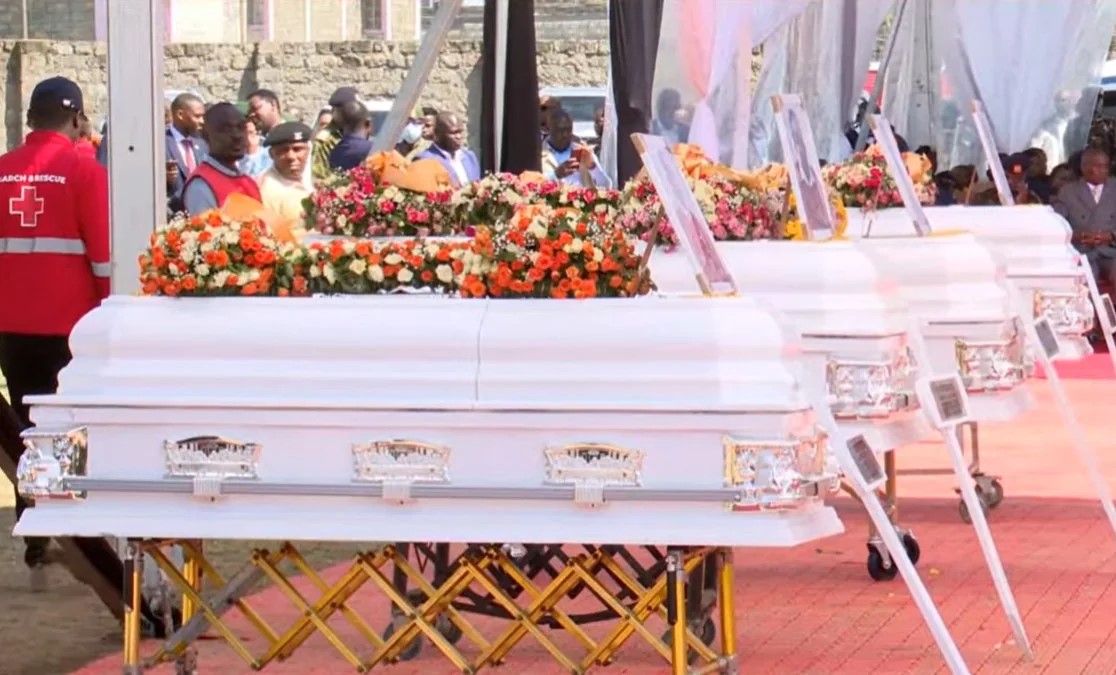
The Utumishi Girls High School fire killed 16 girls. Utumishi Girls is a national police service school situated near police and military camps in Gilgil. Behind guarded gates. Under state security oversight. The CCTV footage captured everything; the arsonists tiptoeing between beds, the kerosene being poured, the flames spreading. The cameras watched. No one stopped them. And still, 16 children burned to death.
Before Utumishi, there was Kyanguli (2001). Sixty-seven boys burned. Before Kyanguli, there was Machakos Girls (2005). Twelve girls burned. Before Machakos, there was Moi Girls (2017). Ten girls burned.
And before all of them, there was St. Kizito (1991). Seventy-one girls were raped. Nineteen died when boys broke into their dormitory. The principal’s response: “The boys never meant any harm against the girls, they just wanted to rape.”
That was 35 years ago.
We have not learned.
After every tragedy, the same cycle repeats. Outrage. Promises. CCTV cameras installed. Then silence. Until the next dormitory fire, the next sexual assault, the next news cycle.
We are treating symptoms while the disease remains. The disease is not arson. It is not sexual violence. It is the absence of quality day schools.
The contradiction we refuse to see
A child from a local primary school excels in a day school, walking home every evening to the same family, the same bed, the same mother’s cooking. He meets the criteria for a famous boarding school less than 15 minutes from his home. The same home. The same family.
But the school will not admit him as a day scholar. He must board. He must sleep in a dormitory under CCTV cameras, separated from the family that raised him to excel.
What changed? Not the child. Not the family. Not the distance. Only the school’s convenience. This is not education policy. This is institutional inertia protecting a brand.
The manufactured crisis
The crowding in boarding schools is not an accident. The view that day schools are for failures is not a natural prejudice. Both were manufactured by decades of deliberate policy choices.
We starved day schools of resources, then pointed at their emptiness as proof that day schooling does not work.
A day school receives the same capitation as a boarding school on paper. But the boarding school also collects boarding fees, tens of thousands of shillings per child. The day school has no such cushion. When capitation is delayed (as it routinely is) the day school simply stops functioning. The boarding school continues, because parents have already paid.
The day school is set up to fail. Then we mock it for failing.
A teacher who requests transfer from a national boarding school to a county day school is asked: “What did you do wrong?” The assumption is that day school is a demotion. The best teachers cluster in the best boarding schools. The day schools receive the newly hired, the unproven, the temporary. Then we compare exam results and conclude: “See? Boarding schools perform better.”
The teacher distribution is rigged. Then we celebrate the rigged results as proof of superiority.
This is the cruelest irony of Kenyan education: we created the crisis, then punished parents for responding to it rationally. A parent who chooses a boarding school is not making a free choice. The day school near their home may lack a laboratory, may lack qualified teachers, may lack consistent water and electricity. The parent is not rejecting day schooling. The parent is responding to the reality the government created.
The solution is not to tell parents to choose differently. The solution is to make the day school choice as good as the boarding choice.
The brand that feeds itself
The famous boarding schools endure because their alumni endure. Graduates of these schools occupy high offices in government, the judiciary, corporate boardrooms, and the media. They hire each other. They promote each other. They send their own children to the same schools.
And when policy debates arise, about funding, about placement, about the future of education, they advocate for the brand that made them. Not because they are evil. Because they are loyal. Because the brand gave them success, and success breeds gratitude, and gratitude blinds them to the injustice of the system that produced it.
The result is a self-perpetuating aristocracy of education.
The brands receive more funding because their alumni are in positions to allocate funding. They receive better teachers because principals know that a posting to a national school is a career achievement. They receive better infrastructure because CDF committees, county governments, and private donors compete to be associated with excellence.
The day schools receive nothing. Because no one powerful advocates for them. Because the powerful did not attend them.
The divide deepens. The brands grow stronger. The day schools grow weaker. And we call this “merit.”
But merit had nothing to do with it. A child born in a rural village, attending a local day school with no laboratory, no qualified chemistry teacher, and a leaking roof: that child is not competing on merit. That child is competing against a system that was rigged before they were born.
The alumni networks do not see this. Or they see it and look away. Because looking away is easier than admitting that their success was built on a foundation of inequality that they now, unconsciously, perpetuate.
The arithmetic we cannot ignore
Kenya loses an estimated KSh 3 billion daily to corruption. For KSh 200 million, we can build a fully stocked day school with laboratories, libraries, and maximum 40 learners per class.
KSh 3 billion per day builds 15 such schools. Every single day. Nearly 4,000 per year.
Kenya needs approximately 22,580 well-equipped day schools to serve our 11 million learners. At the rate we lose money to corruption, we could build every school we need in six years. Six years. Then no child would ever need to sleep in a school dormitory again.
The money exists. It is being stolen.
The trauma we refuse to name
Ask any adult who passed through boarding school: “What was the worst period of your life?” For a shocking number, the answer is boarding school.
The first night, crying into a pillow so the prefects would not hear. The hunger between supper at 6 PM and breakfast at 6 AM. The cold, the thin blanket, the window that would not close. The queue for the toilet at 5 AM. The cruelty of children when no adult is watching. The letters home that said “I am fine” when nothing was fine.
But there is deeper trauma. The trauma of growing up away from home during the most vulnerable period of human development.
The first period, far from mother. A girl bleeds for the first time in a dormitory toilet at 5 AM, surrounded by strangers, using a torn piece of notebook because she does not know where the matron keeps the sanitary pads. She does not tell anyone. She sits through morning preps, through breakfast, through the first three lessons, bleeding through her uniform, because she is ashamed and there is no one to hold her hand.
The first nocturnal emission, far from father. A boy wakes up in a strange bed, in a strange room, in the middle of the night, and does not understand what has happened to his body. He lies still, terrified, listening to the breathing of 50 other boys, and he does not call out. He carries the shame silently, for days, for weeks, until he learns from a classmate that this is what happens to boys. Not from his father. Not from an uncle. From another child who also does not know what he is talking about.
The emotional roller-coaster, without a single adult who knows you. Puberty is chaos. The hormones, the moods, the inexplicable sadness, the sudden rage, the desperate need for someone
to see you and the equally desperate fear of being seen. A child needs an adult who knows their history, their triggers, their silences, their particular shape of distress. A teacher cannot be that adult for 200 children. A matron cannot. A prefect certainly cannot.
The metamorphosis, witnessed only by peers. Children achieve sexual maturity away from home, shaped not by parents but by other children who are equally lost. They learn about sex from whispers in the dormitory, from magazines passed under blankets, from older students who have learned from older students. They learn that love is transactional, that bodies are objects, that intimacy is something to be ashamed of.
And we wonder why teenage pregnancy is high. Why sexual violence is normalised. Why young people struggle to form healthy relationships.
The stranger who comes home for holidays. After one term, the child returns home. But the child who left is not the child who returns. This new person has different habits, different humour, different silences. They do not know how to sit at the dinner table and make conversation. They do not know how to be touched. They flinch when a parent reaches for them, not from abuse but from sheer unfamiliarity with affection.
The parents try. The child tries. But the gap grows. By Form Four, they are polite strangers sharing a house.
These costs do not appear in any budget. They cannot be offset by any revenue. They are pure loss.
The pressure to perform
Inside these camps, the pressure is relentless.
The child must wake at 4:30 AM. Run to preps. Study until breakfast. Run to class. Study through lunch. Run to afternoon preps. Study through supper. Run to evening preps. Study until 10 PM. Sleep. Repeat.
Some schools have a “movement by running” policy. No walking. No lingering. No moment of rest. The body is always in motion, always supervised, always performing. The child learns that rest is laziness, that stillness is suspicious, that the body exists to obey.
Sleep deprivation is normalised. Six hours for a growing adolescent brain when the research is clear: adolescents need 8-10 hours. We give them six. Then we wonder why they are anxious, depressed, unable to concentrate, quick to anger.
The pressure is to perform; to get the grades, to make the brand proud, to justify the sacrifice of being sent away.
And for what?
The mathematics of disappointment
In the 2025 KCSE examination, only 0.19% of candidates attained a mean grade of A. Just 1,932 students out of nearly a million.
Only 27.18% qualified for direct university admission with a grade of C+ and above. Nearly 73% of students who sat for the national examination did not qualify for university.
Think about that. The boarding school system: the pressure, the sleep deprivation, the separation from family, the cameras in dormitories, the trauma. Produces these results. For the majority of children, the sacrifice yields nothing but a certificate that leads nowhere.
How many children, separated from their families, sleeping six hours a night in a dormitory under CCTV, crying themselves to sleep, bleeding alone in toilet stalls, actually achieve that university cut-off?
We do not know. Because we do not count. We count the successes. We build statues to the brands. We celebrate the 0.19%.
We do not count the 73% who are left behind.
The culture shock of freedom
And then they go to university. Or TVET. Or nowhere.
For those who do make it to university, the freedom is a shock. After four to six years of being told when to wake, when to eat, when to study, when to sleep (after years of being watched by cameras and prefects and matrons) the young person arrives on campus and is suddenly free.
No bell. No curfew. No uniform. No one telling them what to do. And they bungle it.
The NACADA study on drug and substance use among university students reveals the scale of the crisis: 45.6% of university students have used drugs or substances at least once in their lifetime; 25% are current users; and one in every 12 students is struggling with addiction.
The risk factors are predictable: peer pressure, stress, and financial freedom. The very things that the boarding school system never taught them to manage.
After years of being controlled, they do not know how to control themselves. After years of being watched, they do not know how to be alone with their own choices. After years of suppressing their emotions, they do not know how to feel without numbing.
The boarding school system does not produce adults. It produces prisoners who have been released without parole.
No wonder the costly social experiments with sex and illicit drugs drag many into future regrets if not early graves.
The cruelest irony
The boarding school system was designed, supposedly, to produce excellence. To insulate children from the distractions of family and community. To focus them entirely on academic achievement.
But the data tells a different story:
- Only 0.19% achieve A
- Only 27.18% qualify for university
- 73% do not qualify
- 45.6% of those who do make it to university have used drugs
- 25% are active users
- 1 in 12 is addicted
The system fails the majority. Then it hands the survivors to addiction. Then it celebrates the brands.
And we wonder why Kenya is not progressing.
The security we cannot guarantee
Boarding schools sell safety. Utumishi is a national police service school, under state security oversight, guarded, near police and military camps, with CCTV in dormitories. Sixteen girls still burned to death.
A famous school produced excellence for decades. It also produced a teacher who groomed students for 26 years while the faculty suspected and the system protected the brand. When former students protested, the school called the police on them.
If a school under state security oversight – guarded, near military camps, with cameras – cannot protect children, what hope does any ordinary boarding school have? The cameras do not prevent harm. They only document it. And no one has answered the question: who has been watching the footage of our children undressing?
The policy that already exists
The government has already taken the first step. Primary boarding for Grades 1-9 is abolished. The Ministry has acknowledged that children as young as six should not sleep in institutions.
But the logic does not stop at Grade 9. If it is wrong for a 12-year-old to board, why is it acceptable for a 13-year-old in Form One? The same family, the same home, the same need for parental nurture.
We must extend the policy to secondary education. Make day schooling the default. Let boarding be a genuine choice for families who want it; not a necessity because the local day school is inadequate.
The reform that must be wholesome
The Competency-Based Curriculum is the biggest reform Kenya has ever attempted. But a curriculum reform without a structural reform is like painting a house while the foundation is cracking.
CBC requires practical, community-based learning. How does a child do that from a dormitory 200 kilometres from home? How does a parent participate in their child’s education when the child only comes home during holidays?
The boarding school model is fundamentally incompatible with CBC. One requires connection to home and community. The other requires severing that connection.
The simple solution
We must transition away from compulsory boarding. Not overnight. Not cruelly. But deliberately, with a clear timeline and adequate funding.
First, stop building new boarding schools. Every new public school must be a day school.
Second, introduce proximity in placement. A child who lives near a school should be offered a day scholar place. Use the National Education Management Information System (NEMIS) to prioritise local admission.
Third, fund day schools adequately. The Sh22,244 capitation per learner must be disbursed in full and on time. No more delays, no more shortfalls. Redirect the billions saved from boarding utilities, catering, and dormitory maintenance to laboratories, libraries, and teacher recruitment.
Fourth, equalise teacher distribution. The 1:26 teacher-student ratio looks good on paper but hides deep inequality. Boarding schools are overstaffed; day schools are understaffed. Reshuffle teachers to seed excellence everywhere. A teacher from a famous boarding school can succeed in a local day school if given the same resources and support.
Fifth, audit CCTV in dormitories. The Office of the Data Protection Commissioner must inspect every boarding school. Cameras in private spaces where children undress are illegal. Remove them. And answer the question: who has been watching?
Sixth, listen to the adults who suffered. Conduct a national conversation about boarding school experiences. Count the cost of the tears, the trauma, the estrangement. Let the testimony finally enter the policy debate.
The bottom line
Kenya has the money. KSh 3 billion lost daily to corruption proves it.
Kenya has the teachers. 458,000 serving 11 million learners, with the ratio almost at UNESCO target.
Kenya has the policy framework. Primary boarding is already abolished. TVET has been transformed.
Kenya has the precedent. Every functional education system in the world prioritises day schooling. Finland, Japan, Canada—children walk to school and go home to their families.
What Kenya lacks is the will to prioritise children over brands, dignity over surveillance, and prevention over reaction.
From St. Kizito (1991) to Utumishi (2026), the evidence has been mounting for 35 years. We have not learned. The children are still bleeding. The brands still guard the gates. The government still installs more cameras.
The children are crying. It is time to listen. It is time to bring them home.
YOU MAY ALSO READ: Kenya’s Schools Need Quality Assurance Audits, Not Inspection Visits
The writer is a concerned Kenyan citizen.