





























- In a rapidly changing East African landscape, organisational success is no longer defined by strategy alone, but by the ability to continuously adapt, align, and execute with agility at every level.
- The future belongs to institutions that move beyond rigid systems and embrace leadership driven agility, where reinvention, collaboration, and human centred thinking shape sustainable growth.
- As disruption becomes constant, enterprise agility is emerging not as a choice but as the defining capability for organisations seeking to remain relevant, competitive, and impactful.
Across East Africa’s fast evolving economies, a quiet but powerful shift is underway. From Kenya’s thriving innovation ecosystem to Rwanda’s digital governance ambitions and Tanzania’s expanding infrastructure landscape, organisations are being forced to rethink not just what they do, but how they operate. Reinvention is no longer a future consideration. It is an immediate and continuous demand shaping leadership decisions across sectors.
It is within this context that the PMI Agile Alliance has introduced the Manifesto for Enterprise Agility, a leadership guide aimed at helping organisations respond to disruption while maintaining clarity of purpose and execution. Rather than focusing on isolated projects or teams, the manifesto challenges institutions to embed agility at the core of leadership, governance, culture, and operating models.
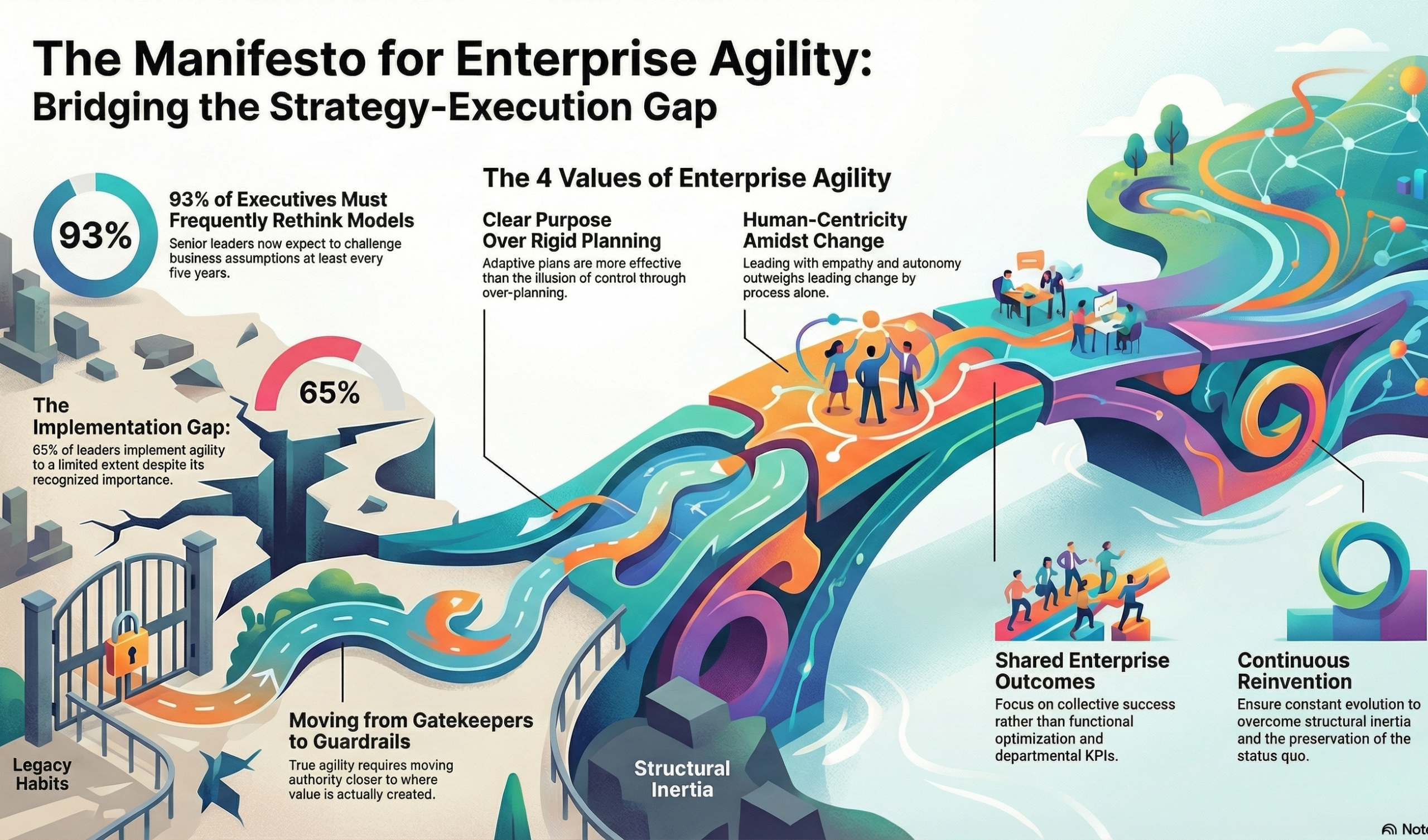
Launched in Nairobi on April 1, 2026, the initiative builds on insights from PMI global C suite research, which reveals that 93 percent of senior executives are compelled to rethink their business models at least every five years, with nearly 65 percent doing so every two years or even more frequently. In the East African Community, where businesses and governments are rapidly scaling across borders, this cycle is often shorter, exposing a persistent gap between strategy and execution.
This gap remains one of the most pressing challenges for organisations today. While 85 percent of C suite leaders acknowledge the importance of enterprise agility, 65 percent admit that implementation remains limited or has not been achieved at all. The implication is clear. Knowing what to do is no longer enough. The real test lies in translating strategy into coordinated and sustained action.
“Most organisations do not struggle with strategy. They struggle with turning strategy into coordinated action. Enterprise agility is about building organisations that can adapt quickly without losing alignment, so leaders can respond to disruption while keeping their people and priorities focused on delivering value,” explains George Asamani, the Managing Director for Sub Saharan Africa at PMI. .
Marking 25 years since the Manifesto for Agile Software Development reshaped thinking in the technology space, this new framework expands the conversation beyond software into the broader enterprise. It recognises that agility must move from technical teams into leadership systems, decision making structures, and institutional culture. For East Africa, where fintech innovation, public sector reforms, and regional infrastructure projects are accelerating, this shift reflects an urgent operational reality.
Rather than prescribing rigid frameworks, the manifesto advances a more adaptive philosophy. It encourages leaders to govern with guardrails instead of gatekeepers, to fund intent rather than isolated activities, and to decentralise decision making to the points where value is created. This approach aligns with the region’s growing emphasis on collaboration, innovation, and cross border integration.

The Manifesto is anchored on four core values that redefine how organisations can lead, adapt, and deliver impact in an increasingly complex environment:
- Clear purpose realised through adaptive plans: Guiding with a clear sense of purpose while remaining flexible in execution proves more effective than rigid planning or the illusion of total control.
- Shared enterprise outcomes over functional optimisation: Emphasising long term organisational goals and cross enterprise collaboration delivers greater value than isolated departmental performance metrics.
- Continuous reinvention over preservation: Challenging existing operating models and embracing innovation is more impactful than maintaining legacy systems and resisting change.
- Human centricity amidst change: Prioritising continuous learning, resilience, autonomy, and leadership grounded in empathy and trust strengthens organisations beyond reliance on processes alone.
Industry leaders and global thinkers have underscored the urgency of this shift.
“Twenty five years after the Manifesto for Agile Software Development presented a new way to think about software development, it is time to apply similar thinking to enterprises, not just to projects or products. Just as the Agile Manifesto responded to major technological shifts driven by the internet, the growth of physical and digital networks now compels organisations to embed agility across leadership, operating models, execution governance, and culture,” observes Greg Beato, co-author of Superagency.
Industry leaders are increasingly aligning on one central truth: agility is no longer a technical concept confined to systems and processes, but a strategic imperative shaping how organisations compete and survive in a rapidly evolving global economy.
“Today’s business landscape demands rapid adaptation and greater agility. Agile organisations adapt faster and take the lead, while those that fail to embrace agility risk falling behind as collaboration becomes essential in a dynamic environment,” notes Kevin Nolan, Chief Executive Officer of GE Appliances.
Beyond systems and structures, there is a growing recognition that the success of enterprise agility ultimately rests on leadership mindset and the willingness to challenge deeply rooted organisational norms.
“Enterprise agility is less about frameworks and more about leadership courage. It is the courage to reset vision, dismantle legacy assumptions, and trust teams to execute within systems designed for speed. This manifesto captures a critical truth. Enterprise agility is not a transformation initiative, but a leadership mindset required to continuously reinvent vision, structure, and execution in a volatile world,” explains Sagar Kochhar, former Chief Executive Officer and co-founder of Rebel Foods.
Rooted in extensive PMI research, including global executive surveys and insights from transformation leaders, the manifesto reflects a shared reality across industries. In East Africa, where organisations are simultaneously scaling, integrating, and digitising, the ability to adapt quickly, execute effectively, and remain aligned across complex systems is fast becoming the defining advantage.
YOU MAY ALSO LIKE: Africa Infrastructure Boom Faces Widening Construction Talent Gap, PMI Warns