






























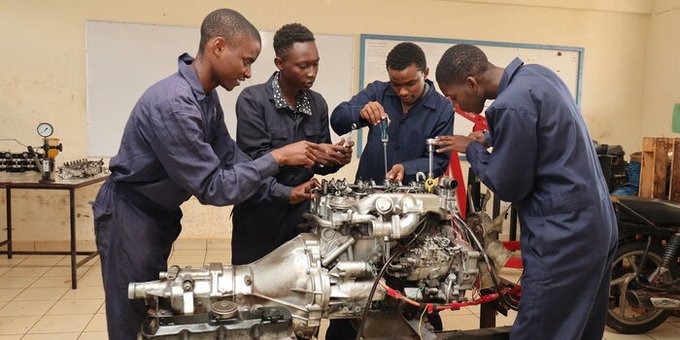
- Kenya’s universities must return to their core mandate of teaching, research, innovation, and degree training, while allowing specialized TVET institutions to lead in practical skills development and technical education.
- The declining enrolment, weak financial returns, and limited competitiveness of university-owned TVET institutes demonstrate that specialization, not institutional expansion, is the key to a stronger and more sustainable higher education system.
- For Kenya to build a workforce that is both academically competent and technically skilled, universities and TVET institutions must embrace their distinct roles and focus on delivering excellence within their respective mandates.
For decades, Kenya’s universities occupied the entire spectrum of higher education. Before 2012, it was common to find a university offering certificate courses, ordinary diplomas, bachelor’s degrees, postgraduate diplomas, master’s degrees, and PhDs all under one institutional roof. To many universities, certificate and ordinary diploma programmes were not only avenues for expanding access to education and a feeder into their degrees, but also important sources of internally generated revenue.
However, the promulgation of the Constitution of Kenya 2010 fundamentally reshaped the country’s education architecture. In the years that followed, several laws were either developed and enacted or revised to align with the new constitutional order. Among the most significant were the Universities Act 2012, the Basic Education Act 2013, and the Technical and Vocational Education and Training (TVET) Act 2013.
The spirit and intention of the Universities Act 2012, which established the Commission for University Education (CUE), was clear: universities were expected to concentrate on university education. In essence, universities were no longer supposed to offer certificate and ordinary diploma programmes. The only diploma programme envisioned within universities was the postgraduate diploma.
This policy direction was further reinforced by the enactment and operationalization of the Technical and Vocational Education and Training Authority (TVETA) framework under the TVET Act. The intention was to create a clear distinction between university education and technical training, with traditional middle-level TVET institutions, like National Polytechnics (NPs), Technical Training Institutes (TTIs), Teachers Training Colleges (TTCs), and Vocational Training Centres (VTCs), becoming the primary custodians of hands-on technical training.
Rise of University-Owned TVET Institutes
However, despite the legal and policy shift, many universities were unwilling to completely let go of certificate and diploma programmes. Faced with shrinking government capitation and declining revenues, publics universities viewed these programmes as an important component of their appropriation-in-aid collections. As CUE gradually stopped accrediting ordinary diploma and certificate programmes, universities became innovative – or perhaps evasive – by establishing semi-separate TVET institute subsidiaries, within their institutional structures.
These university TVET institutes, often headed by directors and accredited by TVETA, Kenya Accountants and Secretaries National Examinations Board (KASNEB) and the likes rather than CUE, mushroomed across the country. At the time, the model appeared strategic. Universities hoped to retain the lucrative diploma market while complying with the new legal framework. Some institutions even marketed their TVET centres aggressively, banking on the prestige associated with university brands.
But more than a decade later, the experiment appears to be faltering. Across many universities, TVET institutes are increasingly posting poor returns on investment and becoming financial liabilities and burdens rather than strategic assets. Instead of strengthening universities financially, they are draining the little but critically needed resources available to already struggling institutions.
One of the clearest indicators of the crisis is the sharp decline in student enrollment. In many university TVET institutes today, some programmes admit fewer than five students per trimester (based on three semesters per academic year). Workshops and lecture halls designed for dozens of trainees remain largely empty. In some cases, laboratories are underutilized. Expensive equipment purchased at great cost gathers dust as student demand continues to dwindle. This is not to mention the underutilization of instructors.
University TVETs on the downward trend
The reasons behind the declining enrollment are not difficult to identify.
First, university TVET institutes have largely failed to match the commitment, agility, and practical orientation associated with middle-level TVET institutions which have for decades, built a culture of practical skills development. Their training systems are structured around workshops, laboratories, studios, industrial attachments, and competency-based instruction.
In contrast, many university TVET institutes operate within rigid university bureaucracies that are historically designed for academic and theoretical learning rather than practical skills training. As a result, the training offered in many university TVET centres are overly theoretical. In addition, learners tend to be over-taught, especially if the instructor happens to be a degree programme lecturer; read a PhD holder. A quick survey indicates that learners in university TVET institutes are typically handled and taught by university administrators for finance, procurement and administration courses etc, while technicians and technologists handle the Science, Technology and Engineering courses as internal part-timers. The motivation behind the involvement of these cadre of staff is more fiscal than interest or ability to deliver.
A student pursuing electrical engineering at a national polytechnic is likely to spend significant hours handling tools, wiring systems, troubleshooting machines, and engaging in industrial practice. Meanwhile, a similar student in some university TVET institutes may spend more time in lecture rooms than in workshops. Employers notice this difference immediately.
Second, attachments in universities are sizably misplaced. It is not uncommon to find attachees placed in an industry that does not match their course of study. This explains why many industries continue to prefer graduates from middle-level TVET institutions for technical and artisan roles. Whether in chemistry technology, electrical engineering, building construction, automotive engineering, or accountancy programmes, Kenya’s middle-level TVET institutions continue to produce more hands-on graduates than many university-affiliated TVET centres.
Third, university TVET institutes tend to charge comparatively higher fees while offering limited financial support to students. Most students seeking TVET education come from economically vulnerable backgrounds and are highly sensitive to cost. Learners in public TVET institutions often have the benefit of access to government scholarships, bursaries, and financial aid programmes that significantly reduce their financial burden. University TVET institutes, however, are totally excluded from such support systems. The government never invests directly in them, and students enrolled therein often miss out on important state-backed financing opportunities.
The situation is worsened by the fact that the Kenya Universities and Colleges Central Placement Service (KUCCPS) does not normally place students into university TVET institutes in the same way it supports placements into mainstream public middle-level TVET institutions and public universities (for degree programmes). Without government-backed placement pipelines, these institutes rely heavily on direct student applications, aggressive marketing, and institutional reputation — strategies that are increasingly proving insufficient in a highly competitive education sector.
At the same time, universities themselves are facing severe financial distress. Across the country, public universities are struggling with unpaid statutory deductions, salary arrears, pending part-time lecturer claims, and unpaid rent obligations. Some institutions are barely managing their core academic operations. In such an environment, maintaining underperforming TVET institutes becomes economically unsustainable. Universities continue owing trainers, maintaining facilities, servicing equipment, and financing administrative structures for programmes that generate minimal returns. In some cases, the cost of sustaining the institutes exceeds the revenue collected from students.
The irony is difficult to ignore. The university TVET Institutions established to strengthen university revenue streams are now deepening financial holes. Beyond the financial concerns lies a more fundamental policy question: should universities even be in the TVET business in the first place?
Focus on Comparative Advantage
Kenya’s education reforms envisioned a differentiated system where each category of institution focuses on its comparative advantage. Universities were expected to concentrate on advanced teaching, research, innovation, and professional degree training. TVET institutions, on the other hand, were meant to specialize in technical skills development, artisan training, and competency-based education. Blurring these boundaries has created institutional confusion and unnecessary competition.
Instead of universities trying to imitate polytechnics, perhaps greater national value would be achieved if each institution strengthened its core mandate. Kenya urgently needs strong universities capable of conducting impactful research, producing quality graduates, and driving innovation. Equally, the country needs robust middle-level TVET institutions capable of producing highly competent technicians, artisans, and technologists.
My advice, as a seasoned educationist in the university, who has watch the TVET space for years is that; parents must make careful decisions when selecting institutions for their children. Many are attracted by the prestige associated with university names without fully interrogating the quality, affordability and nature of training offered. They should know that prestige alone does not guarantee employability.
For students seeking hands-on technical skills and affordable training supported by government financing, national NPs, TTIs, TTCs, and accredited schools of TVET remain the stronger option in many cases.
Universities, meanwhile, may need to make difficult but necessary decisions. Instead of continuing to pour scarce resources into money-sucking TVET institutes with shrinking enrollment and weak returns, they should consider shutting them down or consolidating these centres and redirecting resources toward strengthening their core degree programmes, research capacity, staff welfare, and academic infrastructure. A number of universities with progressive leaderships have since quit the TVET space and re-focused.
The university TVET experiment may have emerged out of institutional survival instincts during a period of financial uncertainty. But the evidence increasingly suggests that the model is neither economically sustainable nor educationally competitive. Truth be told, universities can never match middle-level institutions in delivering TVET programmes.
In the end, Kenya’s higher education sector must confront a difficult truth: not every institution can successfully do everything. Sometimes, prosperity lies not in expansion, but in specialization, focus, and excellence within one’s core mandate.
YOU MAY ALSO READ: Rethinking University Identity in Kenya: Niches and Flagship Programmes
The Author is a Professor of Chemistry; a former Vice-Chancellor; a Higher Education Expert; a Quality Assurance Consultant and Trainer. Contact: okothmdo@uoeld.ac.ke