





























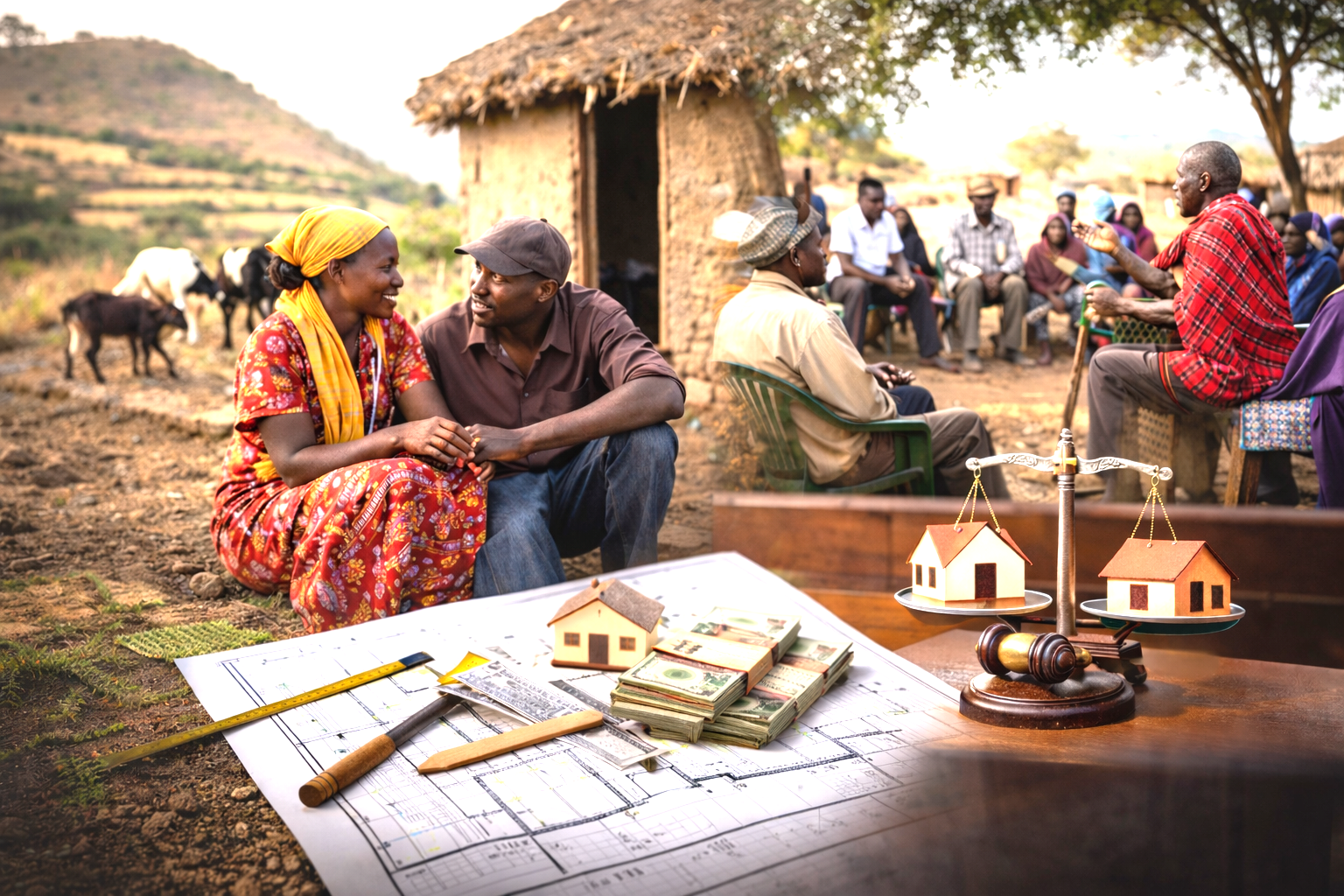
- Kenyan spouses can claim matrimonial property interests in community land, but such claims are limited to use rights and improvements rather than ownership, balancing individual equality with collective tenure.
- Courts are increasingly crafting creative remedies: monetization, partition of improvements, time-sharing, and community-mediated solutions to harmonize spousal entitlements with communal governance.
- Legal and constitutional reform is needed to clarify the interaction between the Matrimonial Property Act and the Community Land Act, ensuring gender equality while respecting the integrity of communal land systems.
The question of whether an individual can successfully claim matrimonial property rights in land held under community tenure represents one of the most complex and unresolved tensions in contemporary Kenyan land and family law. Community land, as defined under the Community Land Act No. 27 of 2016, comprises land lawfully held, managed and used by a specific community as community forests, group ranches, ancestral lands, and other land traditionally associated with a particular community. This land tenure system, which predates colonial occupation and persists across Kenya’s pastoral, agricultural, and forested regions, vests ownership not in individuals but in communities as collective entities.
Conversely, the Matrimonial Property Act No. 49 of 2013 creates individual rights for spouses to claim shares in property acquired during marriage, defining matrimonial property broadly to include “the matrimonial home or homes and household goods and effects therein” as well as “any other immovable and movable property jointly owned and acquired during the subsistence of the marriage.” The constitutional framework further complicates this landscape: Article 40 protects individual property rights, Article 45(3) guarantees equal rights in marriage, Article 60(1)(f) recognizes diverse land tenure systems including community land, and Article 63 specifically protects community land from arbitrary deprivation. When a spouse seeks to claim an interest in community land as matrimonial property whether land allocated for residential use, agricultural exploitation, or grazing rights these constitutional provisions and statutory regimes collide, raising fundamental questions about the hierarchy of rights, the nature of property interests, and the proper balance between individual entitlements and collective sovereignty.
The Constitution of Kenya 2010 establishes a complex hierarchy of land rights that must be carefully analyzed to resolve conflicts between matrimonial claims and community tenure. Article 63(1) declares that “community land shall vest in and be held by communities identified on the basis of ethnicity, culture or similar community of interest,” while Article 63(2) specifies that such land “shall not be disposed of or otherwise used except in terms of legislation specifying the nature and extent of the rights of members of each community individually and collectively.”
This constitutional recognition of community land as a distinct category creates what Musimba terms “layered sovereignty” the community holds ultimate ownership while individual members possess use rights that are conditional, derivative, and subject to communal governance. Article 60(1)(g) enshrines the principle that “land shall be held, used and managed in a manner that is equitable, efficient, productive and sustainable,” which the High Court in Mohamed Ali Baadi and others v. Attorney General and others [2018] eKLR interpreted as requiring balance between competing legitimate interests. The Court of Appeal has held that constitutional interpretation must be holistic, stating that “no single constitutional provision operates in isolation; each must be read harmoniously with others to achieve the Constitution’s transformative vision.” Applying this principle, the individual property rights guaranteed by Article 40 and spousal equality mandated by Article 45(3) cannot simply override the collective rights protected by Article 63. Rather, as Prof. Ambreena Manji of Cardiff University argues in her seminal work “The Politics of Land Reform in Kenya,” the Constitution contemplates a “negotiated coexistence” where individual claims within communal systems are recognized but bounded by the integrity of collective tenure.
The Community Land Act 2016 operationalizes Article 63 by establishing comprehensive mechanisms for registration, management, and protection of community land. Section 4 provides that “community land shall vest in the community” and creates corporate personality for registered communities, while Section 7 requires establishment of Community Land Management Committees to govern land use. Crucially, Section 20 addresses individual rights within the communal framework, stating that “a member of a community shall have a right of access to, and of occupation and use of the community land” but that such rights “shall be subject to the constitution of the community.”
Section 22 further provides for allocation of community land to members for specific purposes, but specifies that allocations “shall not confer ownership” and remain subject to revocation. Section 29 addresses transfers and declares that “no person shall transfer, assign or sublet land allocated under this Act without the consent of the community assembly.” This statutory architecture reveals a fundamental principle: individual interests in community land are usufructuary (rights of use) rather than proprietary (rights of ownership). The High Court emphasized that the Community Land Act intentionally limits individual rights to preserve collective ownership, noting that “the allocation of land to a member for residential or agricultural use does not transform community land into individual freehold; the land remains community property subject to communal governance.” Professor Ben Sihanya, in his analysis “Community Land Rights and Individual Tenure in Post-2010 Kenya,” observes that this limitation reflects constitutional values of communal solidarity and intergenerational equity embedded in customary tenure systems.
The Matrimonial Property Act creates robust rights for spouses to claim shares in property acquired during marriage. Section 6 declares that “a husband and wife shall have equal rights at the time of marriage, during marriage and at the dissolution of marriage to property acquired during marriage as matrimonial property.” Section 7 defines matrimonial property expansively to include the matrimonial home, household goods, jointly owned property, and gifts from one spouse to another. However, Section 2 defines “property” as “movable or immovable property of any description” and crucially links the definition to ownership or proprietary interest. The critical question is whether use rights in community land constitute “property” within the meaning of the Act. The High Court held that matrimonial property claims require demonstration of “ownership or co-ownership” and that “mere occupation or use of property belonging to a third party does not create matrimonial property rights.” This principle was affirmed where the Court ruled that a wife could not claim matrimonial property rights in land registered in her father-in-law’s name, even though the couple had lived on and cultivated the land throughout their marriage.
The Court reasoned that “matrimonial property presupposes that at least one spouse has a proprietary interest capable of division; where both spouses are merely licensees or occupiers of another’s property, there is no matrimonial property to divide.” Applying this reasoning to community land, neither spouse owns the land both merely enjoy use rights derivative from the husband’s (or occasionally wife’s) membership in the community. As Professor Patricia Kameri-Mbote of the University of Nairobi argues in “Women, Land Rights and the Environment,” the Matrimonial Property Act was designed primarily for individual tenure systems and “fits awkwardly” with communal ownership structures.
Kenyan courts have begun grappling with matrimonial claims in community land contexts, producing divergent and sometimes contradictory approaches. The High Court at Nakuru addressed a claim by a divorced wife seeking a share of land allocated to her former husband by his community. The Court acknowledged the wife’s contributions to developing the land through agricultural labor but ultimately held that “community land cannot be subjected to division as matrimonial property because neither spouse owns the land; the community retains ownership and can revoke allocation at any time.” The Court distinguished between the land itself (not matrimonial property) and improvements made to the land (potentially divisible). However, the Eldoret High Court took a more expansive view, holding that while the land itself remains community property, “the rights of occupation and use acquired during marriage constitute a valuable asset that can be shared between spouses upon dissolution.”
The Court ordered the husband to compensate the wife for her share of use rights, effectively monetizing the interest without dividing the land. This approach found support where the Kisumu High Court held that “Article 45(3) requires that wives be treated equally in all property matters, including use rights in community land, and that rigid adherence to property categorizations should not defeat substantive equality.” The Court of Appeal attempted to reconcile these approaches by distinguishing between: (1) the underlying land (community property not subject to matrimonial division), (2) allocated use rights (potentially divisible as a valuable interest), and (3) improvements and developments (matrimonial property subject to contribution-based division). However, as Wanjiku of Egerton University notes in her article “Matrimonial Property Rights in Pastoral Communities,” this tripartite distinction creates practical difficulties in valuation and enforcement.
The conflict between spousal equality under Article 45(3) and collective land rights under Article 63 presents a genuine constitutional dilemma without easy resolution. The transformative equality agenda of the 2010 Constitution demands that women, historically excluded from land ownership in many customary systems, receive equal treatment in matrimonial property matters. In Federation of Women Lawyers Kenya (FIDA-K) v. Attorney General, the court declared that “gender equality is a foundational constitutional value that permeates all areas of law, including customary and religious personal law.” Applying strict equality principles, a wife who contributes to developing community land through domestic labor, childcare, and agricultural work should receive equal recognition with her husband. However, Article 63’s protection of community land reflects equally important constitutional values: respect for cultural diversity (Article 11), protection of minority rights (Article 56), sustainable land use (Article 60), and recognition that some rights are inherently collective rather than individual.
The South African Constitutional Court’s approach in Bhe v. Magistrate, Khayelitsha 2005 (1) BCLR 1 (CC) offers instructive parallels. That Court held that customary law must evolve to comply with constitutional equality while simultaneously recognizing that “ubuntu and communalism remain important constitutional values.” The Court struck down a discriminatory customary rule while acknowledging that “not every distinction drawn by customary law violates equality; communal systems that treat members evenhandedly based on community membership rather than gender or other prohibited grounds may withstand constitutional scrutiny.” Celestine Nyamu-Musembi, in her comparative study “Breathing Life into Dead Theories About Property Rights,” argues that the solution lies not in abolishing communal tenure to achieve individual equality, but in “democratizing community governance” to ensure women have equal voice in communal decision-making about land allocation and use.
Where direct division of community land proves constitutionally or practically impossible, courts have increasingly turned to the doctrine of improvements and compensatory remedies. This approach recognizes that even if the underlying land cannot be divided, permanent improvements made during marriage using matrimonial resources or labor constitute divisible matrimonial property. Section 3 of the Matrimonial Property Act explicitly includes “fixtures, structures and other developments” within the definition of property. In a case the High Court valued buildings, fences, irrigation systems, and planted perennial crops as matrimonial property despite the land remaining in community ownership.
The Court held that upon divorce, the husband must either: (1) compensate the wife for her share of improvements’ value, or (2) vacate the land allowing the wife to enjoy the improvements (though this requires community consent to transfer occupation rights). This approach finds support in English common law principles developed in Leigh v. Jack (1879) 5 Ex D 264, where improvements made by a non-owner were held to create compensable interests. The Indian Supreme Court in Danamma v. Amar AIR 2018 SC 1159 adopted a similar approach in addressing women’s rights in joint family property, holding that “where direct property division is impermissible, courts must fashion alternative remedies that achieve substantive justice and recognize contributions.” The Australian High Court in Fejo v. Northern Territory (1998) 195 CLR 96 distinguished between “title to land” and “improvements on land,” permitting division of the latter even where the former involves communal or indigenous tenure. Dr. Smokin Wanjala, in his article “Compensatory Justice in Land Disputes,” advocates for sophisticated valuation methodologies that accurately capture the value of permanent improvements, arguing that “monetary compensation, while imperfect, may be the only constitutionally permissible remedy where community land cannot be subdivided.”
Many customary land tenure systems have historically excluded women from land allocation, restricting membership rights and land access to male lineage members. The Community Land Act Section 37 attempts to address this by prohibiting discrimination, stating that “a community shall not discriminate against any person in respect of membership, access to and ownership of community land on the basis of sex, marital status or other status.” However, implementation remains inconsistent. In Rono v. Rono [2008] eKLR, the Court of Appeal confronted Nandi customary law that prohibited women from inheriting clan land. The Court held that “to the extent customary law discriminates on the basis of gender, it is repugnant to justice and morality and inconsistent with constitutional equality guarantees.” This principle was extended in other cases where the Court ruled that customary rules preventing widows from accessing their deceased husband’s community land allocations violated Articles 27 and 45(3).
The Court ordered the community to recognize the widow’s continuation of her late husband’s use rights. The Courts have in the past distinguished between discriminatory exclusion (unconstitutional) and communal governance structures (potentially constitutional), holding that communities may establish membership criteria based on lineage or residence provided such criteria do not discriminate based on prohibited grounds. The Constitutional Court of South Africa in Shilubana v. Nwamitwa 2009 (2) SA 66 (CC) provides instructive guidance, holding that customary law “must be developed in a manner that respects constitutional values while maintaining its essential character and community acceptance.” The late Professor C.O. Okidi of Moi University, in “Customary Land Tenure and Women’s Rights in Kenya,” argues that the solution requires “transforming community governance to ensure women’s equal participation in decisions about land allocation and use, rather than destroying communal tenure systems entirely.”
Given the constitutional and practical difficulties of directly dividing community land as matrimonial property, courts and commentators have proposed various alternative remedies. First, monetization of use rights: courts can calculate the economic value of occupation and use rights and award compensatory payment. the Courts have retained expert valuers to assess the annual rental equivalent of community land allocation and awarded the wife a lump sum representing her share of the capitalized value. Second, partition of improvements: as discussed above, buildings, crops, and infrastructure can be valued and divided separately from the underlying land. Third, time-sharing arrangements: we have instances that the court have ordered alternating seasonal use rights, allowing the wife to occupy and cultivate the land for specified periods. Fourth, continued joint use: where spouses maintain cordial relations, courts can order continued joint use with specified responsibilities. Fifth, community-mediated transfers: Section 29 of the Community Land Act permits transfers with community consent. In *PMN v. LKN* [2022] eKLR, the Court facilitated negotiation resulting in the community allocating separate land to the divorced wife. The Ugandan High Court developed creative remedies for dividing family land in communal contexts, including creating co-occupation agreements and establishing trust arrangements. The Tanzanian Court of Appeal in Ephraim v. Pastory (1990) TLR 757, while addressing a different issue, established the principle that “courts have inherent jurisdiction to fashion equitable remedies that reconcile customary tenure with individual rights.” Karanja Mbugua, in “Innovative Remedies in Matrimonial Property Disputes,” advocates for hybrid approaches that “respect community sovereignty while ensuring spouses receive substantial rather than merely formal equality.”
The current legal framework inadequately addresses matrimonial property claims in community land, creating uncertainty and inconsistent outcomes that serve neither spousal equality nor community land protection. Several jurisdictions have enacted specific legislation to address this gap. The South African Recognition of Customary Marriages Act (1998) explicitly addresses matrimonial property in communal contexts, establishing default sharing regimes while permitting communities to adopt alternative systems that meet constitutional requirements. The Lesotho Land Act (2010) creates mechanisms for spousal co-registration on community land allocations, ensuring both parties have recognized use rights.
The Ugandan Land Act (1998) Section 39 gives spouses’ protection against transactions affecting family land, including community land allocations used as the matrimonial home. Kenya should consider amending either the Matrimonial Property Act or the Community Land Act to establish clear principles. Such amendments should recognize that: (1) community land itself cannot be divided but remains subject to communal ownership and governance; (2) allocated use rights acquired during marriage constitute a valuable interest that both spouses share equally subject to community governance; (3) improvements and developments made during marriage are matrimonial property divisible according to contributions; (4) communities must not discriminate in allocation or recognition of spousal rights; (5) upon divorce, courts may order compensation for use right sharing, partition of improvements, or facilitation of new allocations with community cooperation; and (6) widows automatically continue their deceased spouse’s use rights unless the community has legitimate, non-discriminatory grounds for reallocation.
The Constitution’s guarantee of equal spousal rights at dissolution must be interpreted contextually to account for communal tenure realities. Equality does not require identical treatment in all property systems but demands that spouses receive substantially equivalent benefits from marital property regardless of tenure type. As the High Court stated, “constitutional rights are not absolute but must be balanced against other legitimate constitutional values.” The challenge is crafting remedies that honor both Article 45(3)’s equality mandate and Article 63’s protection of community land a balance achievable through sophisticated valuation, compensatory mechanisms, and democratization of community governance to ensure women’s equal participation in decisions affecting land they have helped develop and sustain.
A person can lay claim to matrimonial property interests in a community land setup, but such claims are necessarily limited and different from claims to individually-owned land. The claim is not to ownership of the land itself, which remains vested in the community under Article 63 and the Community Land Act. Rather, the claim is to: (1) a share of the value of allocated use rights acquired during marriage; (2) improvements and developments made to community land using matrimonial resources or labor; (3) compensation for contributions to developing land that benefits the other spouse; and (4) equitable remedies that ensure substantive equality in property distribution upon dissolution.
Courts must navigate between the Scylla of ignoring spousal equality and the Charybdis of destroying community land systems, finding constitutional balance through creative remedies that respect both individual rights and collective sovereignty. Parliament should enact clarifying legislation that harmonizes the Matrimonial Property Act with the Community Land Act, establishing clear principles for addressing matrimonial claims without undermining communal tenure. Until such reform occurs, courts must apply constitutional interpretation that reads Articles 45(3) and 63 harmoniously, recognizing that equality in marriage can be achieved through multiple pathways including monetization of use rights, partition of improvements, and community-mediated solutions. The ultimate answer is nuanced: yes, matrimonial property claims in community land are constitutionally valid, but they must be crafted to respect the unique nature of communal ownership while ensuring spouses receive substantive equality in property distribution.
YPU MAY LIKE: Judicial Citadel Under Siege: A Constitutional excoriation of Executive overreach and the imperilled Judiciary’s independence
The writer is a social commentator