






























- Competency-Based Education should extend across all education levels to develop holistic, competent graduates.
- The TVET pathway should be completed to Level 10 through Technical Universities within the KNQF framework.
- A unified, competency-based education system will strengthen innovation, industry, and sustainable national development.
Abstract
This article responds to Prof. Maurice Okoth’s three linked papers: first, that Competency-Based Education (CBE) should stop at Grade 12; second, that universities should exit the TVET space (a position I fully support); and third, his rebuttal to my proposal that apex TVET institutions should become Technical Universities under the TVET sub-framework.
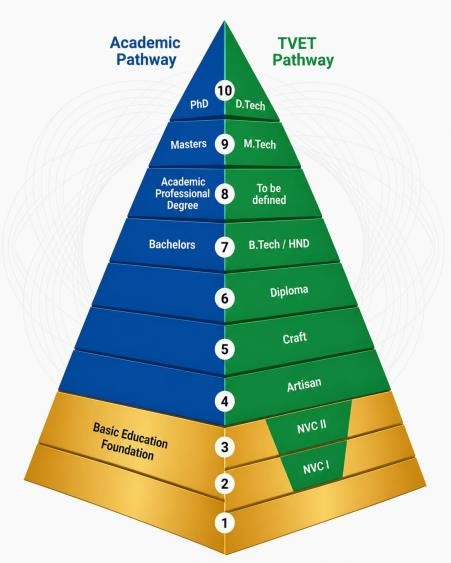
I argue that CBE, properly understood as the integrated mastery of knowledge, skills, values, and attitudes, must be embedded across all levels of education, from basic to doctoral. Viewing the Kenya National Qualifications Framework (KNQF) as a tetrahedron, with a base of basic education and three rising faces (Academic, TVET, and Industry), the article proposes completing the TVET sub-framework to Level 10, with Technical Universities awarding the higher levels of technical education, namely: B.Tech, M.Tech, and D.Tech as a complement to the academic pathways of Bachelor’s, Master’s, and PhD degrees.
Completion of this higher level in the TVET pathway is only possible when Technical Universities are domiciled within the TVET pathway. International precedents and Kenya’s own commitments support this vision. The article concludes by inviting discussion and action around the upcoming 2026 WFCP World Congress in Nairobi.
1. Returning to the Central Question: CBE Beyond Grade 12
Prof. Okoth’s opening salvo asked whether Competency-Based Education (CBE) should extend to university education. His answer was: stop at Grade 12. That question has never been publicly answered. I wish to return to that core question.
CBE is not a mechanical checklist. Properly understood, competency is the integration of knowledge, skills, values, and attitudes, demonstrated through adaptive performance in authentic contexts. That definition is already embedded in the Kenya National Qualifications Framework (KNQF), where every level describes what a learner knows, can do, and can apply.
Let us consider the following: a physicist who cannot solve differential equations or design an experiment is not a physicist. Equally, a theologian who cannot read original texts or trace doctrinal history is not contemplating; they are guessing. Competency, therefore, is not the enemy of breakthrough thinking. It is its foundation.
With this understanding of competency as the key output of any educational approach, the logical position is that CBE should be embedded across all levels of training, from basic education through to the highest doctoral studies. The real question therefore shifts from whether CBE should extend to university education to how it should be extended in ways that respect disciplinary diversity, theoretical depth, and academic freedom. Phased pilots, discipline-specific frameworks, and pyramid mentorship are concrete proposals for achieving this.
I am eager to discuss the how. But first, let us acknowledge this logical starting point: competency as the central output, and therefore CBE as the organizing principle for all levels of education.
2. The KNQF as a Single Tetrahedron: Three Faces Rising, One Base
The second diversion has been the claim that my proposal for Technical Universities under TVET creates an “unnecessary parallel path.” This misunderstands the KNQF’s architecture.
I invite the reader to view the KNQF in three dimensions: as a three-faced tetrahedron.
The base of this tetrahedron is basic education (pre-primary through JSS to SSS). Rising from that base are three distinct faces:
| Face (Sub-framework) | Focus | Role |
| Academic | Fundamental research | Generates new “why” knowledge |
| TVET | Applied research | Turns “why” into “how” – innovations, products, processes |
| Industry | Work-based learning | Embeds “how” into the economy |
The proposed framework below depicts the three distinct faces of a solid pyramid, clearly showing that differentiation is not duplication. All the sub-frameworks share the same foundation of basic education and converge at the apex (Level 10). For clarity, I have “zoomed in” on the Academic and TVET faces of the tetrahedron, while the Professional/Industry training pathways remain on the other faces of the pyramid, facing away from the viewer.
Already, the KNQF distinguishes the three sub-frameworks because a healthy education and economic ecosystem requires specialization within unity. My proposal for Technical Universities as the apex of the TVET sub-framework does not create a new divide. It simply completes the TVET face of the tetrahedron, which is currently unfinished.
Consequently, pitting conventional universities against Technical Universities is a category error. They are two of the three rising faces of the same tetrahedron. Though they have different orientations, they are part of one unified structure.
3. TVET Reforms: The Enabler of CBET
The TVET sector did not stumble into Competency-Based Education and Training (CBET) by accident. It was the result of a deliberate, policy-driven overhaul that laid the groundwork for the TVET reform agenda. The TVET Act 2013, the establishment of TVETA and KNQA, and the development of the KNQF were not merely administrative changes. They were the prerequisites for shifting from a content-driven, examination-based system to one centred on demonstrable mastery.
These reforms are still ongoing. We are still becoming, and that is a strength. More importantly, TVET is committed to continuous improvement. Based on these reforms, institutions across the nation are embedding:
- Interdisciplinary approaches that break down silos between traditional trades.
- Dual training that brings industry into the classroom and sends learners into the workplace.
- Recognition of Prior Learning (RPL), which values informal and experiential learning by mapping it to formal qualifications and identifying gaps to be filled.
- Modularization that allows learners to enter, exit, and re-enter at multiple points without losing progress.
- Greening TVET, ensuring that every competency is bathed in the plasma of sustainability.
All these reforms are expressions of one underlying commitment: CBET, delivered through a lens of continuous improvement. They are not separate projects; rather, they are the implementation of the CBET approach, laid brick by brick and continually refined through feedback from industry, learners, and quality assurance.
This brings me to the timeliness of my call. As TVET continues to evolve, let us complete the TVET face of the tetrahedron all the way to Level 10. The foundation is being laid now. The reforms are happening now, with iterative improvements at every stage. Let us build the apex while simultaneously strengthening the lower levels and refining the system as we progress. Waiting would only delay the integration of applied research and professional doctorates into the TVET sub-framework, leaving the face unfinished and the tetrahedron lopsided.
Critically, only Technical Universities (institutions of higher education that fully embrace the CBET approach) operating under the TVET sub-framework can achieve this extension. Without Technical Universities firmly anchored in TVET, the TVET pathway will forever terminate at Level 7 (HND). As noted in Professor Okoth’s earlier publication, conventional universities are hesitant (or may not be designed) to deliver applied, competency-based doctoral programmes; their mission is fundamental research and academic PhDs. The D.Tech, a professional doctorate focused on use-inspired research, therefore has no natural home outside a TVET-anchored Technical University.
If we place Technical Universities under the Commission for University Education (CUE), they will inevitably drift toward conventional academic models, and the TVET pathway will remain truncated. Therefore, the decision is not merely administrative; it is the difference between a complete, autonomous TVET ladder to Level 10 and a permanently unfinished TVET face of the tetrahedron.
We do not need to go back and catch up. We need to build forward—from the base to the apex—simultaneously, with an unwavering commitment to continuous improvement at every level.
That is the meaning of a coherent, living system.
4. Competency as the Lifeblood, Sustainability as the Plasma
In this tetrahedron, what flows through the base and all three faces is competency—the integrated mastery of knowledge, skills, values, and attitudes. Like blood, competency has essential cellular components:
- Knowledge: the fundamental “what” and “why.”
- Skills: the adaptive ability to perform and solve problems.
- Values and attitudes: the ethical and behavioural component.
Just as whole blood cannot be reduced to any single component, competency cannot be reduced to knowledge alone, skills alone, or values alone. It is the dynamic, flowing integration of all three.
But there is a fourth, often neglected, component that gives life to the blood itself: plasma. Plasma is the liquid medium that bathes and nourishes the cellular components, enabling them to function, circulate, and sustain the organism.
Sustainability is the plasma of competency. It is the nourishing, cross-cutting principle that ensures knowledge is not depleted, skills are not extractive, and values are not short-sighted. Without sustainability, competency becomes a temporary (even destructive) force that produces professionals who solve today’s problems by mortgaging tomorrow.
TVET has taken sustainability seriously. Within the State Department for TVET (SDTVET), there is a dedicated division for Greening TVET and Climate Change. Every trainee who passes through our TVET institutions, learning through the CBE approach, emerges as a fully competent professional capable of driving Kenya’s and the global economic agenda without holding the future hostage.
I urge the Academic and Industry faces of the tetrahedron to embrace sustainability through the lens of Education for Sustainable Development (ESD). Let competency be bathed in the plasma of sustainability, ensuring that the knowledge we generate, the skills we deploy, and the values we instil serve not only the present but also future generations.
This competency-based, sustainability-bathed design enables the fluid transition of trainees and professionals across the three pathways (Academic, TVET, and Industry) of the proposed KNQA framework without loss of progress or status. As such, a learner who acquires competency on the TVET face can transfer seamlessly to the Academic face because the underlying currency is the same: demonstrable mastery of knowledge, skills, values, and attitudes, all nourished by the plasma of sustainability.
Crucially, the same competency also flows back into the base. Competent teachers, instructors, and industry professionals who have climbed the tetrahedron return to basic education, enriching it with current knowledge, advanced skills, appropriate values, and a deep commitment to sustainable development. The base is not a passive foundation; it is continuously renewed and elevated by the very competency that circulates throughout the system.
5. The Circulation of Knowledge: How the Three Faces Feed Each Other
The tetrahedron is not a static structure. It is a living system, and its lifeblood (competency) circulates continuously throughout the tetrahedron. This circulation follows a clear, reciprocal cycle.
The Academic face generates new fundamental knowledge. It asks the “why” questions: What is the underlying principle? Why does this phenomenon occur? Its discoveries across various subject areas become the raw material for innovation.
The TVET face takes that fundamental knowledge and asks the “how” questions: How can we use this discovery to solve a real problem? How can we design a product, process, or service that meets a human need? Through applied research, dual training, and competency-based education, TVET institutions (including Technical Universities) translate academic breakthroughs into practical solutions, prototypes, and technologies.
The Industry face takes those practical solutions and asks the “now what” questions: How do we scale this? How do we commercialize it? How do we embed it into the economy to create jobs, improve lives, and generate wealth? Industry is the conduit through which innovations reach the marketplace.
But the circulation does not stop there. Feedback flows back from Industry to the other faces:
- Industry encounters practical limitations (e.g., supply chain bottlenecks, material constraints, and workforce skill gaps). These become new research questions for the Academic face.
- Industry identifies emerging skills needs (e.g., new technologies, new processes, and new regulatory environments). These become new curriculum demands for the TVET face.
- Academic researchers, observing real-world applications, refine their theories or identify entirely new areas of inquiry.
- TVET practitioners, through TVET colleges and Technical Universities, observe how their graduates perform in Industry and adjust their curricula accordingly.
This is not a one-way flow. It is a cycle of continuous renewal in which knowledge is not merely transmitted from Academic to TVET to Industry; it is co-created through mutual interaction.
Consider a concrete example. An academic researcher discovers a new catalytic process for converting agricultural waste into fuel. A Technical University takes that discovery and develops a low-cost reactor prototype suitable for rural conditions. An industry partner scales the reactor, establishes a supply chain, and creates a viable business. When the industry partner encounters a challenge (e.g., the catalyst degrades faster than expected), it becomes a new research question for the Academic face. Meanwhile, the Technical University, observing the degradation, develops a new maintenance protocol and trains technicians on it. The cycle continues, with each face contributing to and drawing from the others.
This cycle is the heartbeat of the tetrahedron. Without the Academic face, there is no new knowledge to apply. Without the TVET face, discoveries remain on the shelf. Without the Industry face, innovations never reach the people who need them. And without feedback from Industry, the entire system becomes disconnected from reality.
Crucially, this circulation relies on competency. The blood that flows through this cycle is not raw knowledge. It is the integrated mastery of knowledge, skills, values, and attitudes. All three pathways must be run by competent people, regardless of the pathway in which they operate.
Therefore, completing the TVET face to Level 10 is not just about adding qualifications. It is about closing the loop by ensuring that the cycle of knowledge creation, application, commercialization, and feedback has a fully developed, recognized, and autonomous pathway for applied research. Without Technical Universities at the apex of the TVET pathway, the TVET face remains truncated, and the circulation of knowledge is incomplete.
6. Global Precedents: Addressing the International Recognition Concern
Prof. Okoth raises a legitimate procedural concern: removing Technical Universities from the conventional university regulatory structure may create uncertainty about international recognition. This is a valid question, but global frameworks already provide clear answers.
Recall that the D.Tech (Doctor of Technology) is a Level 10 professional doctorate within the TVET sub-framework, focused on use-inspired, applied research and distinct from, yet equivalent to, a research PhD.
The following international instruments and models demonstrate that competency-based, applied doctoral qualifications are fully recognized and respected worldwide:
| Model | Key relevance |
| ILO R195 (2004) (Kenya has adopted it) | Defines lifelong learning as encompassing all learning activities that develop competencies and calls for the recognition of qualifications across borders. |
| Tianjin Consensus (2024) (Kenya is a signatory) | Thirty-two nations, including Kenya, committed to the mutual recognition of TVET qualifications and international exchange. |
| Dublin Accord (2002) | Binds professional engineering bodies in Ireland, the UK, Canada, South Africa, Australia, the US, and others to recognize accredited engineering technician programmes, demonstrating that non-university qualifications can enjoy global recognition. |
| Bologna Framework (1999–present) | Forty-nine countries use a learning-outcomes-based three-cycle system (Bachelor → Master → Doctorate) and explicitly recognize professional doctorates (e.g., D.Eng., D.Tech.) as third-cycle qualifications equivalent to research PhDs. |
| Historical Precedent | École Polytechnique (France), founded in 1794, was the first technical university, while Delft University of Technology (Netherlands) awarded the first doctorates in technology in 1905. The D.Tech therefore has a history spanning more than a century. |
| Global Practice: Binary Systems | Germany’s Fachhochschulen (Universities of Applied Sciences) are distinct but equally valued institutions, now with independent doctoral-awarding rights. Ireland’s Technological Universities Act 2018 provides a separate legislative foundation. Nigeria (NBTE) and Uganda (TVET Act) also have independent regulators for technical education. |
Most decisively, the continental body for TVET institutions already affirms this model. The Association of Technical Universities and Polytechnics in Africa (ATUPA), headquartered in Nairobi, Kenya, counts among its 248 member institutions a diverse mix of technical universities, polytechnics, and technical colleges. ATUPA’s mandate is explicitly to promote and transform Technical and Vocational Education and Training (TVET) across Africa. This means that the idea of a Technical University belonging squarely within the TVET family is not a Kenyan innovation; it is the established position of the continent’s own representative body. Kenya is not breaking new ground; it is aligning with a pan-African standard.
These precedents are unambiguous. The question is not whether such a pathway can be recognized, but how quickly we can align our domestic framework with these international commitments.
7. A call to open discussion: Nairobi 2026
Later this year, from November 23 to 28, 2026, Nairobi will host the World Federation of Colleges and Polytechnics (WFCP) World Congress. This landmark event, hosted by ATUPA, will be the first time the Congress is held on the African continent. It will bring together hundreds of institutions from over 50 countries, including many that have already successfully implemented the Technical University model (including Germany, the Netherlands, Ireland, Finland, and others).
Kenya has a rare opportunity. As the host nation, we can move from debating technical universities to streamlining them within the TVET pathway. This will enable them to fully fulfil their mandate in applied research and complete the TVET framework up to the D.Tech apex. We can show the world that Kenya understands what these countries have already demonstrated: a complete, autonomous TVET pathway with its own degree-level apex is not a threat to conventional universities, but a necessary complement.
Therefore, I open this discussion to all stakeholders: policymakers, university administrators, TVET leaders, industry partners, and scholars. Let us use the WFCP Congress as a platform to advocate for:
- A joint commitment to complete the TVET sub-framework of the KNQF to Level 10, with Technical Universities as the apex.
- A multi-stakeholder taskforce (TVET practitioners, university representatives, industry leaders, and international partners) to draft the legal and regulatory amendments required by early 2027, including, if necessary, expanding TVETA’s mandate to cover degree-awarding technical institutions or creating a dedicated Technical University Council.
- A pilot Technical University pathway within one existing apex TVET institution (e.g., Ramogi Institute of Advanced Technology or a Technical University reincorporated into the Kenyan TVET pathway) by the 2028 academic year.
- A Kenyan roadmap presented at the WFCP Congress as a case study for other African nations, demonstrating that a coherent binary system can work on the continent.
This is an invitation to debate, refine, and ultimately act. I hope this conversation reaches all key stakeholders, that the idea is rigorously interrogated, and that we collectively recognize the opportunity before us.
The world is coming to Nairobi. Let us not merely host it—let us show that Kenya is ready to build the future of technical education at the center of national development.
Let us complete the tetrahedron: all three faces to the apex.
YOU MAY ALSO LIKE: Kenya’s Universities Should Exit TVET Space and Refocus on Degree Training
Grade 12 is Enough: Don’t Extend CBE to University Education
Technical Universities and TVET: Kenya Needs Integration, Not Separation
The author is a Senior Technical Vocational Officer (SDTVET). ORCID: 0009-0002-7420-3196. Contact: bmbesu17@gmail.com