


























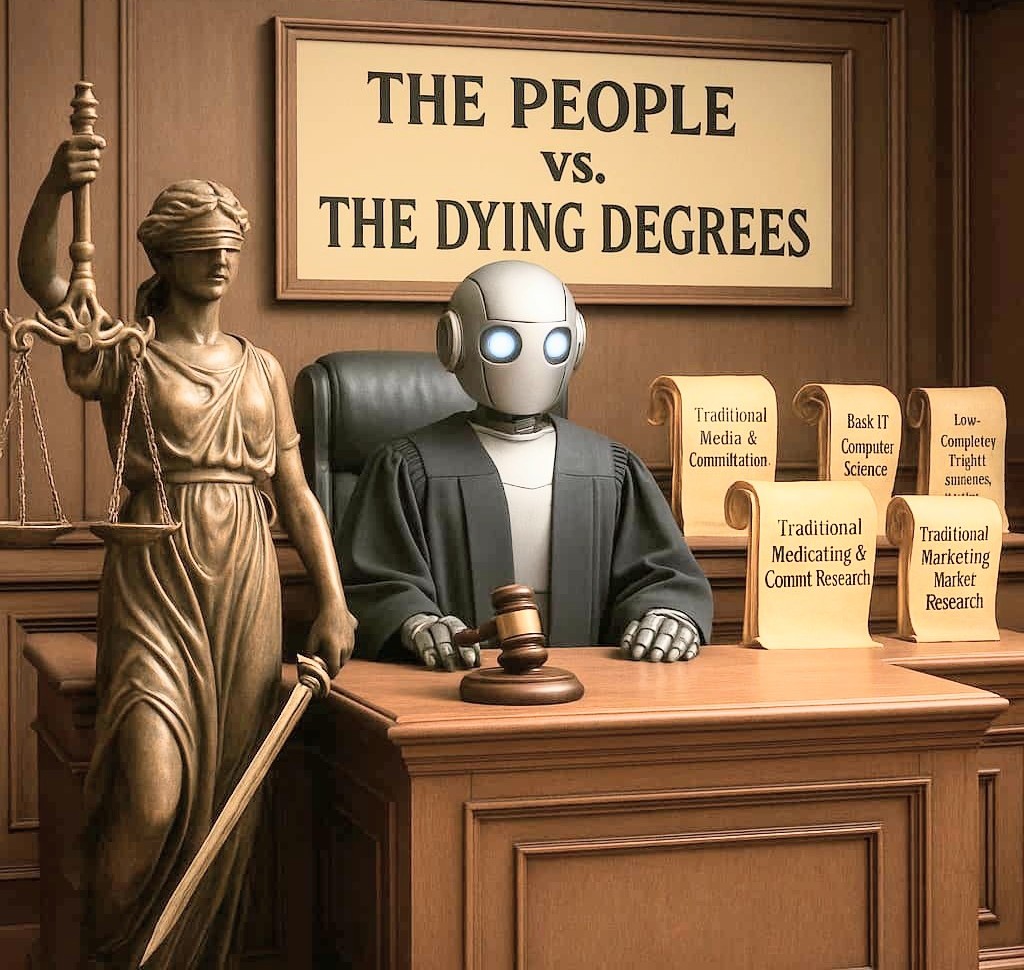
- AI has sounded the trumpet, and not every degree will rise at the resurrection of relevance. Some shall remain buried, like outdated scrolls in a forgotten library.
- It is the education that produced machine-like humans. AI is demanding a new kind of graduate: one who thinks, who feels, who dares.
- On the gravestone of the dying degrees, one epitaph must be written: “Here lies a certificate that trained a human to do what a machine could do better.”
There comes a time in history when the university gown, once majestic, becomes nothing but a costume in a world that has outgrown it. The next ten years will not be about whether one went to school, but what the school put inside them. AI has sounded the trumpet, and not every degree will rise at the resurrection of relevance. Some shall remain buried, like outdated scrolls in a forgotten library.
I. The Degrees That Shall Die
Let us walk into the graveyard of academia. The first tombstone we meet bears the name Clerical Studies. Once proud, it taught young men and women how to push paper, balance ledgers, and type letters. Today, AI balances accounts in milliseconds, drafts contracts in seconds, and manages offices without sweat. The clerical mind is no match for the silicon brain.
Beside it lies the tombstone of Traditional Journalism. The ink that once thundered against tyranny is now competing with algorithms that write faster, cheaper, and with boundless reach. Unless the journalist weds philosophy and courage, their degree is nothing but an obituary in waiting.
A little further, we stumble upon Basic Computer Science—those who learnt only how to code like obedient typists of machines. AI now codes better, without hunger, without sleep, without student loans. The degree that trained mechanical coders is now itself a machine in the scrapyard.
II. The Degrees That Shall Survive
But do not weep endlessly, for the graveyard is not the whole story. There is also the maternity ward of the mind. In it, new degrees are being born.
The first child is AI and Cognitive Sciences—those who do not just use machines, but understand their soul, their logic, their ethics. These are the priests of the new digital temple.
Next is Law in its higher calling—not the paralegal of dusty files, but the philosopher-judge of tomorrow who interprets human dignity against the arrogance of algorithms. When machines misbehave, it is the lawyer who shall rise with the scales of justice.
The third child is Medicine and Nursing, for though machines diagnose, they cannot touch a trembling patient’s hand, nor whisper hope into the ear of the dying. The human touch remains beyond circuitry.
And behold the forgotten child—Philosophy and the Humanities. When the world is drowning in information, it is the philosopher who shall teach us what is worth knowing. As Nietzsche once thundered: “He who has a why to live can bear almost any how.” AI can give us the “how,” but only philosophy preserves the “why.”
III. The Silent Truth
What AI is killing is not degrees—it is degrees without depth. It is the education that produced machine-like humans. AI is demanding a new kind of graduate: one who thinks, who feels, who dares.
The tragedy of Africa is that while the richest men of the West grow fat on intellectual property: patents, algorithms, invisible empires, the richest in Africa still chase cement, sugar, and land. We are trading in sand while the rest of the world trades in thought. That, perhaps, is the most painful funeral of all.
The Epitaph of the Dead Degree
On the gravestone of the dying degrees, one epitaph must be written: “Here lies a certificate that trained a human to do what a machine could do better.”
And on the rising scroll of the future degrees, another inscription must shine: “Here is the crown of the human spirit: creativity, empathy, philosophy, and courage.”
For in the end, AI will not kill knowledge. It will only kill knowledge without soul.
YOU MAY ALSO READ: When the Lion Pauses: A Dialogue Between Legacy and Letting Go
Dr. Isaac Christopher Lubogo is a Ugandan legal scholar, innovator, and author of over 70 books freely available at lubogo.org. A recipient of the SMEGAfrica Excellence Awards, The Scholar of the Year Award 2025, he is the founder of Suigeneris Think Tank and creator of the Suigeneris Law App (suigenerislawapp.com), a one-stop platform for law teaching materials. As a lecturer of law, he inspires future legal minds while revolutionizing legal scholarship and education across Africa.