





























Zombification and Political Holograms
- Disclaimer: This article is a work of critical political philosophy, commentary, and social reflection. All references to real individuals, events, or governments are used purely for scholarly, journalistic, or satirical critique in the public interest. The author does not intend to cause harm, defame, or misrepresent any person, living or deceased. Medical or political conditions described are contextualized hypothetically or illustratively and do not imply personal knowledge of private health matters. Any resemblance to specific circumstances is coincidental and subject to the protections of free academic and political expression as recognized under national and international law. This piece is protected by principles of fair use, academic freedom, and freedom of speech.
Power Without Pulse
In much of post-colonial Africa, politics has become not merely a career—but a tomb. Not a place of service—but a shrine for self-worship. In this sacred but profane theatre of immortality, we witness the paradox of African leadership: men whose bodies are failing—who no longer recognize the days of the week—yet remain politically ‘alive,’ nominated, celebrated, or even worshipped, long after their prime has withered into oblivion.
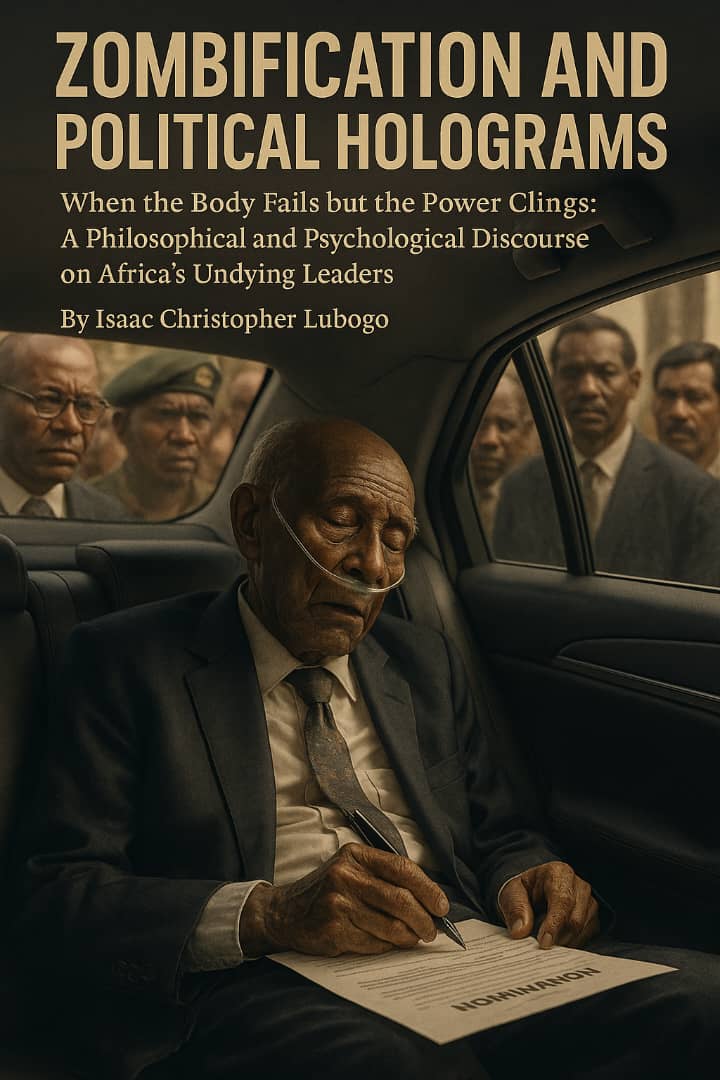
In Uganda, General Moses Ali, at nearly 90 years of age, was nominated for parliamentary office while seated inside his car, too frail to step out, sparking widespread concern about his health. This is not an isolated anomaly. It is part of a broader pathology—deeply rooted in the psychology of fear, the philosophy of legacy, and the theology of power.
- Philosophical Foundations: The Fear of Anonymity and the Illusion of Immortality
African leaders do not simply fear death—they fear irrelevance.
“To step out of power is to step into the void—where no sirens scream, no hands salute, no titles echo back.”
This explains the tragic contradiction: men dying on oxygen tanks still fighting to sign nomination forms. Why? Because African leadership is not transactional—it is transcendental. Power is not a tool; it is an identity. To lose it is not a retirement—it is ontological death.
This fear is partly inherited. Colonial Africa knew only one center of command: the governor. Leadership was singular, absolute, and godlike. That legacy remains.
In many African societies, there is no concept of “private elder statesman.” There are kings—or forgotten corpses. Retirement is humiliation. Thus, men seek immortality in office, clinging to power not because they can serve—but because they fear being forgotten, replaced, or irrelevant.
- The Psychological Dimension: Trauma, Paranoia, and Generational Scarcity
From the genocide of Rwanda to the bush wars of Uganda, the independence struggles of Algeria, and the liberation movements of Zimbabwe, African leaders emerged from trauma—not training. Most post-independence leaders were soldiers, rebels, or survivalists. They fought, bled, and killed for power. To them, power is not a social function—it is a personal reward.
They do not trust the younger generation—not because they are incapable—but because they are not comrades-in-pain.
“He who did not bleed cannot lead.”
So, these leaders keep going—not because they are fit—but because they cannot imagine anyone else worthy. Their paranoia fuels the cycle.
Robert Mugabe, barely coherent in speech, refused to retire until the military escorted him out.
Paul Biya of Cameroon, over 91, is rarely seen in public—yet rules from Geneva hotels.
Abdelaziz Bouteflika of Algeria was re-elected in 2014 while mute and paralyzed, pushed in a wheelchair during campaigns.
This is not leadership. It is the embalming of power—a zombification of governance.
- The Sociopolitical Culture: Patronage, Necrocracy, and Political Holograms
African leadership is less about institutions and more about personality cults.
When a man holds power, he becomes a godfather, not just a servant.
He feeds clans, tribes, military loyalties, and business cartels.
When such a man falls, thousands beneath him also crumble.
Thus, the elite prop up these decaying figures not out of love—but out of dependence. They are not individuals anymore—they are ecosystems.
What we are witnessing is not politics—it is necrocracy:
“Government by the nearly dead, for the already forgotten, kept alive by the still dependent.”
Even when their minds wander, their signatures are needed. Even when they forget their names, their political capital remains too valuable to let go. So, they are wheeled, whispered for, and even drugged into motion, just to sign the next decree.
They become political holograms—appearing real, but functionally absent.
- The Colonial Hangover: Imperial Models of Immortal Rule
Postcolonial Africa inherited not only flags and borders—but the architecture of authoritarianism. Colonial administrators were never elected, never accountable, and never voluntary retirees. They ruled until death or recall from Europe.
“The seat of power was never democratized—it merely changed skin.”
African leaders simply mimicked this model. Power was not passed on—it was clung to.
- The Silence of Doctors: Medical Ethics and the State’s Dark Theatre
When political cadavers are propped up for public display, where are the doctors? Why are medical professionals silent?
In cases like Moses Ali or Bouteflika, medical staff are complicit or coerced—forced to hide terminal conditions behind declarations of “stability.”
This is political necrophilia: ruling through the body of the dying. Ambulances become campaign vehicles. ICUs become power bunkers.
The very dignity of medicine collapses before the altar of politics.
- Theology of Power: When Presidents Become Prophets
In many African religious spheres—both Pentecostal and Islamic—leaders are viewed as divinely appointed.
They are not mere mortals; they are God’s chosen.
To question them is to offend heaven.
To challenge them is to invite ancestral wrath.
To replace them is to sin.
“If he is old, he is wise. If he is sick, he is under spiritual attack. If he is silent, he is meditating.”
This mystical framing explains why power becomes sacred—and succession becomes sacrilege.
- Gendered Truths: Why Women Don’t Rule from the Grave
This zombification of power is largely male-dominated. Rarely do African women remain in office when their faculties fail. Why?
Women are more likely to see leadership as service, not identity.
They are socialized to nurture, not dominate.
They face more public scrutiny for every misstep—so they exit with dignity.
Could it be that patriarchal ego is tied more deeply to political immortality than actual service?
- The Economic Cost of Clinging to Cadavers
This obsession with undying leaders drains nations:
Medical evacuations to foreign hospitals.
State-funded entourages for the barely living.
Bureaucratic paralysis awaiting the “leader’s directive.”
Fragile economies halted by one man’s frailty.
“The price of political immortality is national stagnation.”
Cameroon, Zimbabwe, Nigeria, Uganda—each has paid this cost in silence.
- The Role of the Masses: Spectators of a Tragic Circus
Why do citizens allow this?
Because African leadership is spiritualized.
Citizens don’t vote—they worship.
Leaders are not servants—they are ancestral archetypes.
So even when the president is absent for 80 days (as with Buhari), his return is a resurrection—not a scandal.
The people, numbed by dependency and conditioned by myth, cheer for shadows.
- Global Contrast: The Grace to Exit
Compare this with:
Jacinda Ardern of New Zealand: resigned citing burnout.
Pope Benedict XVI: abdicated for health.
Angela Merkel: stepped aside after her term, in good health.
They left with grace—because they saw power as service, not salvation.
- Legacy vs Longevity: The Fatal Confusion
Nelson Mandela is revered—not because he ruled long, but because he left before power corrupted him.
But many African leaders confuse:
Relevance with presence
Legacy with longevity
Statesmanship with permanent possession
They forget:
“To be remembered is not to remain—it is to release power at the right time.”
What Then Must Be Done?
To break this cycle, we must:
- Demystify leadership: It is a job—not a throne.
- Strengthen institutions: Let systems, not bodies, govern.
- Empower younger generations: Not as heirs, but as innovators.
- Legislate and enforce term and age limits: With no exceptions for age, rank, or legend.
As long as power is seen as the final proof of life, Africa will continue to be ruled by ghosts in designer suits.
But one day, Africa must ask:
“What shall it profit a man if he gains all power—but loses his pulse?”
Until we answer that question with both courage and clarity, the continent will remain a theatre of the absurd, where bodies decay in luxury ambulances, nomination papers are signed with trembling hands, and nations are ruled by shadows of men once called heroes.
“I wanted to live forever—so I died in office. Now, my legacy is not how I led, but how long I refused to leave.”
“And when the nation buries a leader, may it not dig up another from the grave of convenience.”
YOU MAY ALSO READ: When the Lion Pauses: A Dialogue Between Legacy and Letting Go