



























- East African distance running is evolving, with Ethiopia, Kenya and Tanzania shaping an increasingly competitive marathon landscape.
- Africa is moving beyond producing world-class athletes to building platforms capable of hosting the world’s biggest sporting events.
- The future of African athletics will depend on developing talent, strengthening sporting systems and creating opportunities for the next generation.
Berlin was already awake before most of the city had finished its first coffee. Along the broad avenues of the German capital, thousands of runners moved through a sea of spectators, bicycles, barriers and cameras as the familiar streets of the 52nd BMW Berlin Marathon once again became a theatre for one of distance running’s great annual contests.
But somewhere between the 30-kilometre mark and the Brandenburg Gate, Berlin was telling a bigger African story.
Ethiopia was taking control of a race historically associated with Kenyan excellence. Tigst Assefa was chasing a world record that appeared within reach. Guye Adola was pulling away from a leading men’s field, while Tanzania’s Gabriel Geay was fighting for a place on the podium. And Kenya, one of the most successful distance-running nations in history, was facing an unusually quiet Berlin.
Yet for Africa, Berlin was about much more than who stood on the podium. It was a glimpse into how the continent’s distance-running landscape is changing, with Ethiopia displaying remarkable depth, Tanzania strengthening its presence and Kenya confronting a new level of competition.
When the Clock Became Assefa’s Opponent
Assefa arrived in Berlin with history already attached to her name. The Ethiopian had won the race in 2022 and 2023 and was returning to a course where she had previously established herself as one of the world’s leading marathoners. This time, however, the target was bigger: she wanted a personal best, and for much of the race, the world record appeared to be within reach.
The pace was relentless. Assefa passed 5 kilometres in 15:30 and 10 kilometres in 30:48. At 20 kilometres she reached 1:01:34 before crossing halfway in 1:04:57. That halfway split was extraordinary. It was the third-fastest women’s marathon halfway time ever recorded and projected to a finishing time of about 2:09:53, just inside Ruth Chepngetich’s world record of 2:09:56.
For a moment, Berlin looked ready to witness another rewriting of the record books. The pacemakers were doing their job, while Assefa remained composed, checking her watch and maintaining a rhythm that kept the world record within reach. At 30 kilometres, she was at 1:32:15, still projected around 2:09:45.
The clock had become her opponent.
The Record Disappeared. The Champion Did Not.
Marathons, however, are rarely decided by mathematics alone. After 30 kilometres, Assefa’s pace began to change. The physical demand of the effort became increasingly visible, and later in the race she appeared to struggle with a physical problem as her pace dropped. The world record gradually moved away.
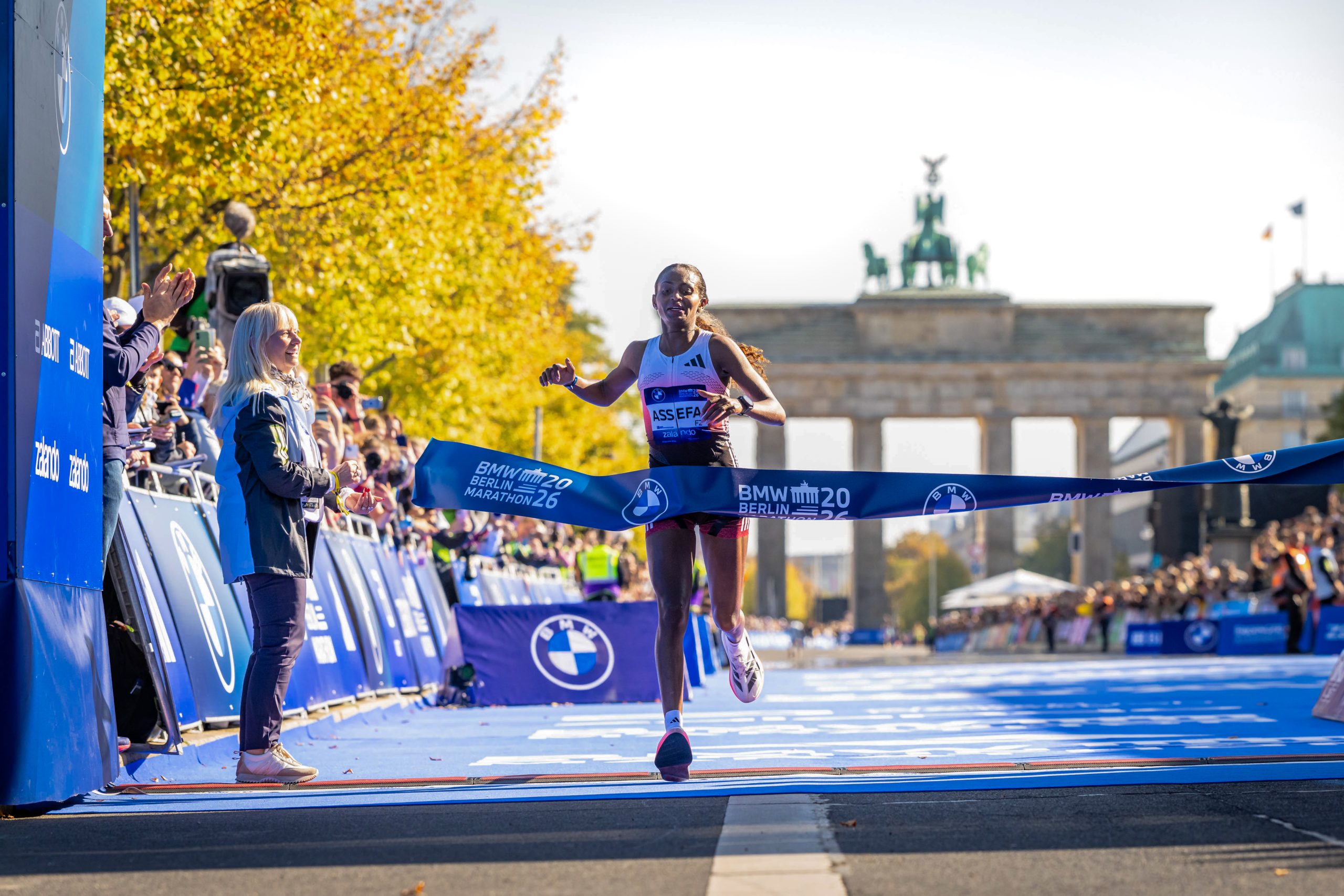
But Assefa had created such a commanding advantage that the race victory was never seriously threatened. She crossed the finish line in 2:11:04, winning her third Berlin Marathon title and taking 49 seconds off her previous personal best and course record of 2:11:53. The time was also the third-fastest women’s marathon ever recorded.
There was another remarkable statistic buried inside her run. Between 30 and 35 kilometres, Assefa covered the distance in 15:17. According to World Athletics, that five-kilometre split alone would have been fast enough to finish 13th in the women’s standalone 5km race at the recent World Road Running Championships in Copenhagen.
The world record did not fall.
The champion still did.
Adola’s Berlin Story Comes Full Circle
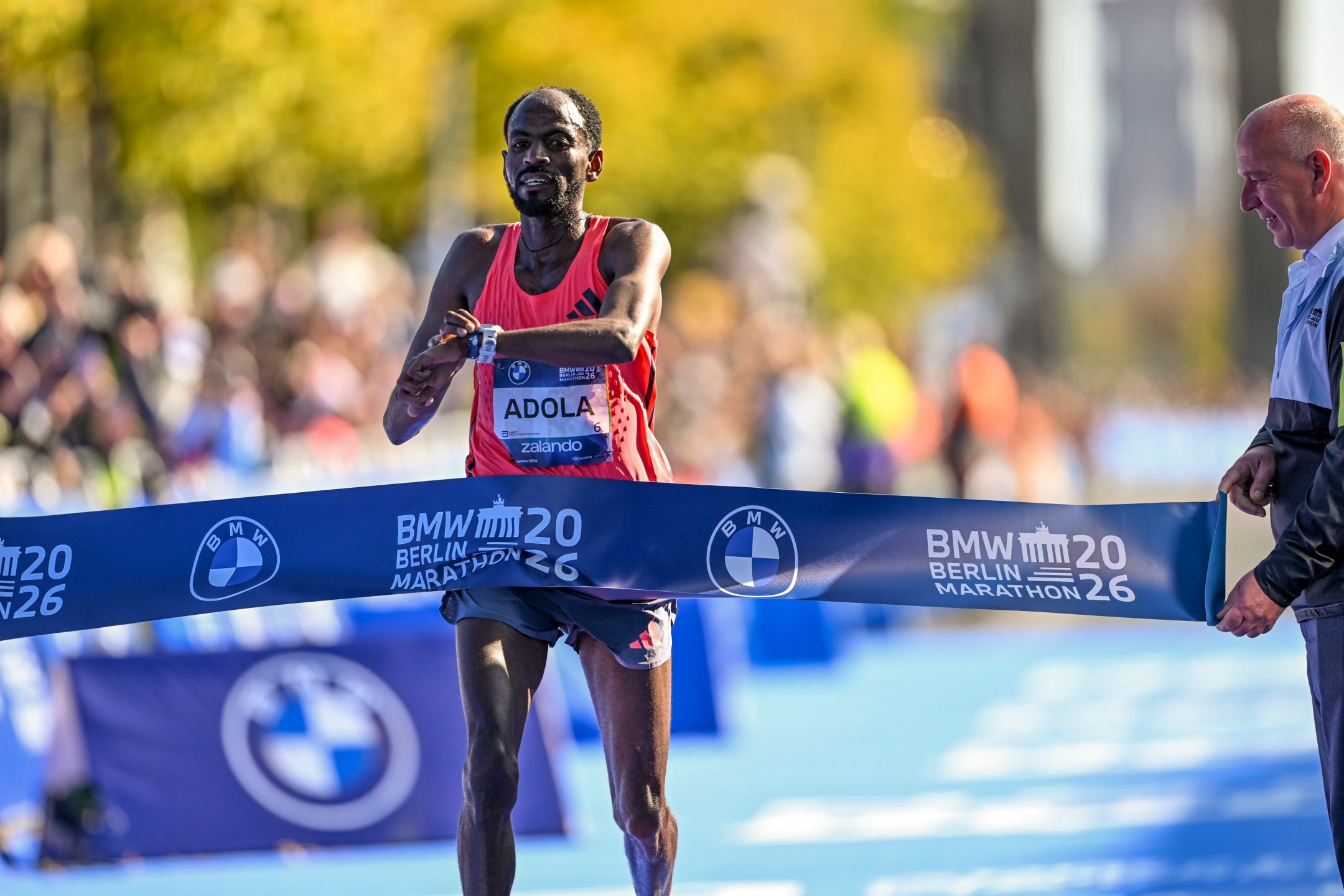
The men’s race produced its own African storyline. Guye Adola had first announced himself on the Berlin course in 2017, when he ran 2:03:46 on his marathon debut. Nine years later, he returned to the same streets and produced a performance that brought his Berlin story full circle.
Adola remained with the leading group through the early stages before gradually taking control. At 30 kilometres, he was leading in 1:26:57, still close to the pace required for a 2:02 finish. As the race entered its decisive phase, the group began to fracture, and Adola eventually made his move with roughly 10 kilometres remaining.
He no longer had a pacemaker ahead of him, but the Ethiopian continued to press. The finish confirmed what the late race had suggested. Adola won in 2:02:50, a personal best and his second Berlin Marathon victory, five years after his first.
Ethiopia also claimed second through Tadese Dida in 2:03:19, while Tanzania’s Gabriel Geay completed the podium in 2:03:59.
It was another reminder that East African distance running cannot be reduced to one country.
Ethiopia’s Depth Changes the Conversation
The women’s podium made that point even more clearly. Ethiopia swept the top five places, with Bedatu Hirpa second in 2:16:53, Dera Dida third in 2:16:55, Bekelech Gudeta fourth in 2:18:58 and Alemitu Tariku fifth in 2:19:01.
Kenya’s Pascaline Jelagat was sixth in 2:20:23, followed by Ethiopia’s Misgane Alemayehu, while Kenya’s Ludwina Chepngetich and Evaline Chirchir finished eighth and ninth, respectively.
The results do not erase Kenya’s long history in marathon running. They do, however, illustrate how deep the competitive landscape has become.
For decades, Kenya and Ethiopia dominated the conversation around African distance running. Today, the picture is becoming broader. Tanzania’s Geay has already established himself among the world’s leading marathoners. Ethiopia continues to produce exceptional depth. Kenya remains a major force, even on a day when its athletes did not reach the podium.
The centre of gravity is not disappearing.
It is expanding.
Kenya’s Quiet Berlin and the Bigger Question
Kenya’s performance in Berlin will naturally attract attention because of the country’s extraordinary record in the event. But one race cannot define a country’s distance-running system. Pascaline Jelagat’s sixth place, Ludwina Chepngetich’s eighth and Evaline Chirchir’s ninth still placed three Kenyans inside the women’s top 10.
The absence of a podium finish is therefore better understood as a snapshot rather than a verdict. The bigger question is what happens next.
Kenya’s athletics system has traditionally been built around an enormous pool of talent, particularly in the Rift Valley. But the international marathon environment is changing rapidly, with deeper fields, sophisticated training systems, professional management and increasingly competitive athletes from across Africa.
The response cannot simply be to protect the past. It has to involve developing the next generation, strengthening athlete welfare, improving coaching and creating pathways that allow young athletes to transition into sustainable professional careers.
East Africa’s Marathon Map Is Getting Wider
Berlin demonstrated something important about the future of African distance running: the continent’s marathon story is no longer a simple Kenya-versus-Ethiopia narrative.
Tanzania’s presence on the podium matters. Ethiopia’s depth matters. Kenya’s continued competitiveness matters. So does the emergence of athletes and systems outside the traditional centres of excellence.
That broader competition can ultimately strengthen African athletics. It creates more rivalries, more opportunities for athletes and more reasons for global audiences to follow African distance running beyond the familiar names.
But another development is taking place away from the marathon course.
Africa is increasingly becoming a stage for global sport.
From Producing Champions to Hosting the World
In November, Dakar will host the 2026 Youth Olympic Games, marking the first time an Olympic sporting event has been held on African soil. Three years later, Nairobi will host the 2029 World Athletics Championships, the first time the senior global championships will be staged in Africa.
Those two events represent a significant shift.
Africa has spent generations producing athletes who travel abroad to compete on the world’s biggest stages. Now the continent is increasingly preparing to bring those stages home.
Nairobi’s successful bid was built around operational planning, financial guarantees, infrastructure upgrades and Kenya’s experience hosting major international athletics events. World Athletics also pointed to the country’s history of hosting the 2017 World U18 Championships, the 2021 World U20 Championships and the Kip Keino Classic.
That raises a question that extends beyond athletics: Can African countries build sporting systems that are not only capable of producing champions, but also capable of hosting the world?
That means much more than a renovated stadium. It means transport systems that work, accommodation, security, medical services, broadcasting, technology, trained officials, volunteers, commercial partnerships and media operations capable of serving a global audience.
The Race Beyond Berlin
Berlin delivered an Ethiopian double. Assefa reminded the world how close human performance can come to the limits of the marathon. Adola turned a personal history with the course into a personal best. Tanzania placed another athlete among the world’s elite. Kenya experienced an unusually quiet day.
But the larger African story is still being written.
The continent is producing champions across generations and, increasingly, developing the confidence to host the competitions that showcase them. Dakar will provide a platform for Africa’s youngest generation of Olympians. Nairobi 2029 will provide an even bigger test.
The question is no longer simply whether Africa can produce athletes capable of winning global championships. It is whether a continent that has spent generations producing champions can build sporting platforms worthy of those champions.
Berlin may have belonged to Ethiopia.
The bigger race belongs to Africa.
YOU MAY ALSO LIKE: Nakuru Golf Club celebrates four-day centennial event, drives progress