






























- A strong education system must balance competency, academic inquiry, and innovation while preserving the distinct purpose and value of each learning pathway
- Sustainable education reforms should be grounded in sound policy, institutional readiness, and quality assurance rather than driven by appealing theoretical models alone.
- National progress depends on strengthening both vocational and university education in complementary ways that foster excellence, research, innovation, and lifelong learning.
The debate over the future of Kenya’s education system has taken a fascinating turn. It began as a discussion on whether Competency-Based Education (CBE) should stretch beyond Grade 12 and has now evolved into a wider philosophical discussion over the architecture of higher education itself. This has created two schools of thought. My argument is a rebuttal to an article titled: – Closing the Loop: Re-anchoring the Debate on CBE and KNQF Tetrahedron that was published in Scholar Media Africa on June 21, 2026.
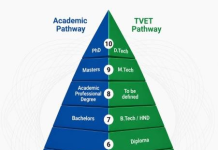
At the centre of this debate is a bold proposition: that the Kenya National Qualifications Framework (KNQF) should be viewed as a tetrahedron, with basic education as the foundation and three equal faces rising toward a common apex—Academic, TVET, and Industry. In this vision, Technical Universities would form the apex of the TVET pathway, awarding Bachelor of Technology (B.Tech), Master of Technology (M.Tech), and Doctor of Technology (D.Tech) qualifications all the way to Level 10.
It is an attractive proposition. It is neat, symmetrical, and ambitious. But the question before us is not whether it is attractive. The question is whether it is educationally sound.
That distinction matters.
Competency is Important, But It Is Not Everything
No serious scholar would deny the importance of competency in education. A graduate must know something, be able to do something, and carry the right values and attitudes.
That much is obvious.
A doctor who cannot diagnose disease, a teacher who cannot communicate knowledge, or an engineer who cannot interpret structural drawings would all be dangerously incomplete professionals. In that sense, competency is indispensable.
But there is a danger in elevating competency into the supreme organizing principle of all education. This is where the debate must be sharpened.
Competency works best where outcomes are visible, measurable, and tied to clear practical tasks. This is why it fits naturally in basic education and vocational training. These are environments where the learner must demonstrate mastery in observable forms.
Higher education, however, especially at postgraduate and doctoral levels, operates differently. Its primary business is not simply performance. It is inquiry. It is ambiguity. It is the freedom to pursue questions whose answers may not yet exist.
A doctoral candidate in philosophy, for instance, is not merely “demonstrating competency.” They may spend years dismantling old assumptions and proposing entirely new intellectual frameworks. Their work may have no immediate measurable output. That is precisely what scholarship demands.
To reduce such intellectual work into competency grids risks turning universities into bureaucratic factories of compliance. And I am convinced that scholarship has never thrived under compliance.
Universities Exist for More Than Utility
One of the strongest arguments in favour of expanding the TVET ladder is that applied knowledge deserves equal institutional dignity. That is true. Applied knowledge matters.
Kenya desperately needs more technicians, technologists, and industrial innovators. But in pushing this agenda, we must not lose sight of the historical mission of the university.
Universities are not simply advanced training centres. They are society’s protected spaces for unrestricted thought. They preserve disciplines that may not have immediate economic value but hold profound civilizational importance.
History reminds us that some of humanity’s greatest breakthroughs emerged from curiosity rather than competency. When Albert Einstein developed the Theory of Relativity, he was not responding to an industry skills gap. When early quantum theorists were formulating abstract equations, they were not building smartphones. When pure mathematicians explored number theory centuries ago, they were not designing modern encryption systems. Yet all these “impractical” pursuits transformed the world.
This is the paradox of higher learning: its greatest value often lies in what seems useless at first. That space must be protected.
KNQF Is Not a Tetrahedron
The tetrahedron metaphor is intellectually elegant, but it may be conceptually misleading. Frameworks such as the KNQF exist primarily to classify qualifications, ensure progression, and establish equivalence across learning systems. They are ladders, not pyramids. They do not erase distinctions between forms of knowledge. By imagining Academic, TVET, and Industry as equal faces of one structure, the model risks flattening crucial functional differences.
The author of tetrahedron article agrees, academic knowledge is foundational. It asks the “why.” TVET asks the “how.” Industry asks the “what now.” These are not interchangeable. TVET depends on the theoretical foundations generated by academic inquiry. Industry depends on both.
This is not an argument for superiority. It is an argument for sequence. Without theory, application has no anchor. Without application, theory has no social reach. But confusing these functions may weaken them all.
Risk of Fragmenting Doctoral Standards
Perhaps the most significant proposal in the tetrahedron argument is the completion of the TVET pathway to Level 10 through D.Tech degrees. At face value, this sounds logical.
Why should applied research not have its own doctorate? It should.
But the challenge is not whether such a qualification should exist. The challenge is governance. If Technical Universities are removed from the jurisdiction of the Commission for University Education (CUE) and placed solely under TVET structures, Kenya risks creating a fragmented higher education system.
Who will determine equivalence between a D.Tech and a PhD? Who will maintain doctoral research quality? Who will protect academic freedom from industrial capture? These questions are not technicalities. They are the backbone of academic legitimacy.
A doctorate is not merely an advanced skill certificate. It is an original contribution to knowledge. That standard must remain universal.
Global Models Are More Complex
Supporters of the Technical University model often cite Germany, Ireland, and the broader Bologna system as proof that this path works. However, these examples deserve closer scrutiny.
Germany’s Fachhochschule system did not emerge overnight. It evolved over decades and gained doctoral powers under tightly regulated partnerships with traditional universities. Ireland’s technological universities remain fully integrated within the national higher education quality framework. Even the Bologna Process recognizes professional doctorates under the same broader regulatory umbrella as academic PhDs.
The lesson here is not separation. It is differentiation within unity. That distinction is critical. Kenya must learn from global practice accurately, not selectively.
Sustainability Is Everyone’s Business
One of the most compelling images in the tetrahedron argument is the idea that sustainability is the “plasma” of competency. It is a powerful analogy, I agree. But sustainability cannot be claimed as the special preserve of TVET.
Some of the most important sustainability breakthroughs have emerged from conventional universities. Climate science, biodiversity research, green chemistry, and renewable energy systems all emerged through long cycles of theoretical inquiry. Environmental Science and Climate Science did not begin as technical modules. They began as questions. That is the point.
Sustainability itself depends on both theory and application. Neither can claim exclusive ownership.
Strengthening TVET Without Weakening Universities
There is no dispute that Kenya must strengthen its TVET sector. The labour market demands it. Industrialization demands it. Youth employment demands it. But strengthening TVET should not mean reconstructing higher education into parallel systems with overlapping doctoral identities and uncertain regulatory boundaries.
The wiser path is balance. Let TVET grow stronger. Let Technical Universities expand applied research. Let professional doctorates emerge where necessary. But let them remain anchored within the national higher education architecture to protect quality, recognition, and scholarly coherence.
That way, Kenya gains both strong vocational systems and strong universities. Not one at the expense of the other.
The Future Demands Complementarity
The appeal of the tetrahedron lies in its symmetry. It offers a picture of order and equal progression. But education is not geometry. It is history, philosophy, and institutional purpose woven together. Competency matters. But so does curiosity. Application matters. But so does abstraction. Industry matters. But so does independent scholarship.
Kenya’s future will not be secured by making every educational pathway look the same.
It will be secured by ensuring that each pathway remains excellent in its own purpose, while collaborating with the others. That is how innovation grows. That is how nations mature. And that is the real loop we must close.
My Parting shot…..
Kenya’s structured TVET subsector is still in its infancy, having only acquired a firm legal and policy foundation through the enactment of the Technical and Vocational Education and Training Act, 2013, which established the Technical and Vocational Education and Training Authority (TVETA) as the regulator of the sector. Barely a decade later, the subsector is still grappling with foundational issues of quality assurance, curriculum harmonization, institutional capacity, industry linkages, and the implementation of reforms envisioned in the Presidential Working Party on Education Reforms (PWPER) report.
There is, therefore, still much ground to cover before we begin constructing ambitious theoretical models such as the tetrahedron. What has worked in Germany or other mature industrial economies cannot simply be transplanted into Kenya without regard to context, history, and institutional readiness. Reform must be evolutionary, not experimental. We must allow TVETA to crawl, then walk, before burdening it with the complex task of hosting and regulating Technical Universities. Kenya’s TVET system needs consolidation before expansion; for now, the tetrahedron remains a vision whose time has not yet come.
As a person. I am really looking forward to taking part in the upcoming World Federation of Colleges and Polytechnics (WFCP) World Congress, from November 23 to 28, 2026, Nairobi, to advance this discourse. I humbly submit.
YOU MAY ALSO READ: Closing the Loop: Re-anchoring the Debate on CBE and KNQF Tetrahedron
The Author is a Professor of Chemistry; a former Vice-Chancellor; a Higher Education Expert; a Quality Assurance Consultant and Trainer. Contact: okothmdo@uoeld.ac.ke